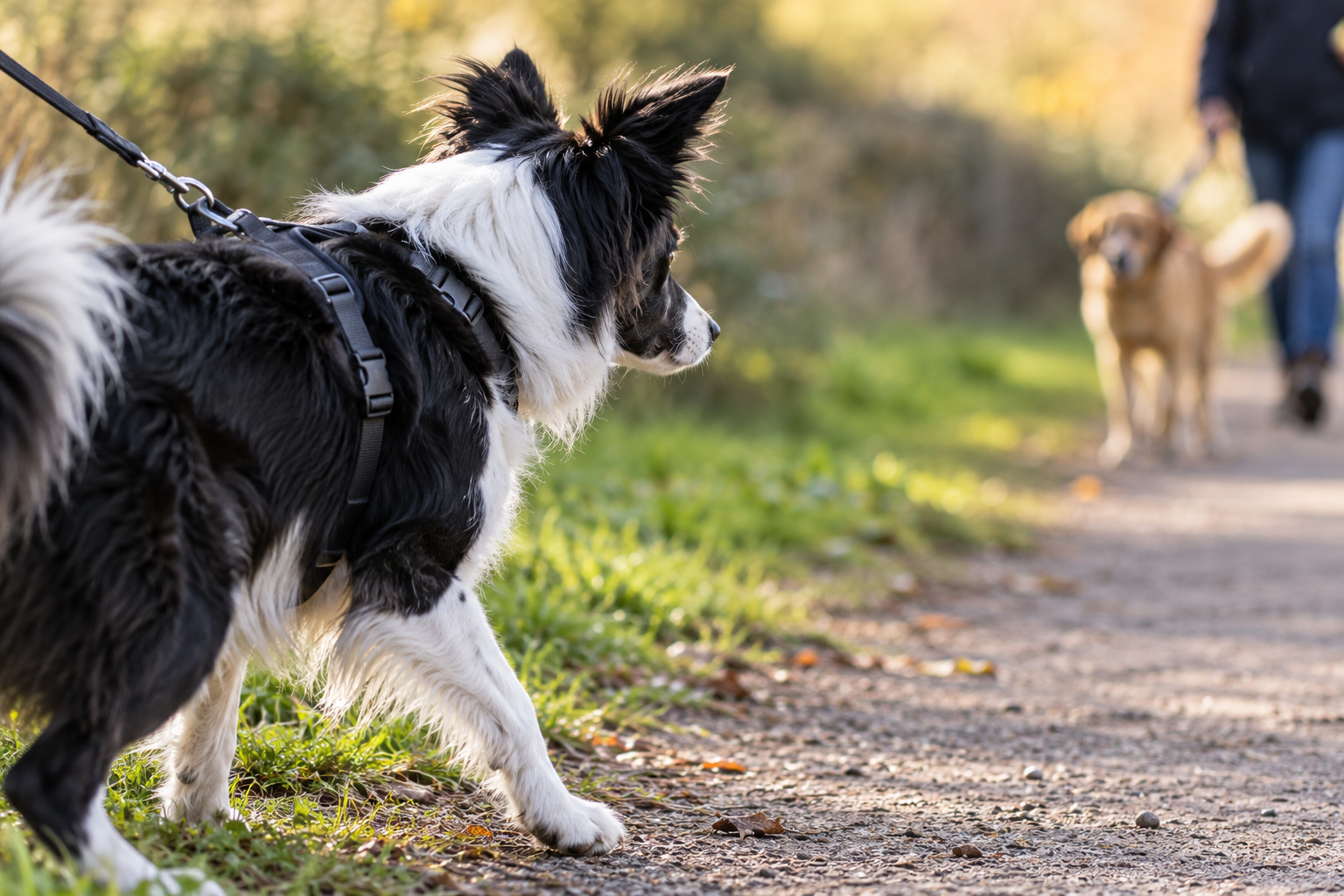
Your dog spots another dog. Their body stiffens, their attention shifts, and suddenly everything you've taught them seems to disappear. But what's actually happening in their brain? 🧠
Your dog knows their name. They know how to walk nicely on the lead. They can respond beautifully to you at home.
But the moment another dog appears?
Apparently, you've never taught them a single thing in their life.
Sound familiar?
It's one of the most common frustrations I hear from owners of reactive dogs.
"He knows what I'm asking him to do. He just won't listen!"
And here's the thing.
You're probably right about the first part.
Your dog may well know exactly what you're asking.
But knowing a behaviour and being able to perform it in a particular emotional state are two very different things.
There's some fascinating science behind why this happens, and understanding it can completely change the way we approach training reactive dogs.
Because sometimes the problem isn't that your dog needs more obedience training.
It's that their emotional response is affecting their ability to use the skills they already have.
What actually is a dog's threshold?
If you've spent any time reading about reactive dogs, you've probably come across the term threshold.
You might have been told:
"Your dog is over threshold."
Or:
"Make sure you keep your dog under threshold."
But what does that actually mean?
In dog training, we generally use the word threshold to describe the point at which a dog's emotional arousal begins to significantly affect their ability to cope, process information or respond as they normally would.
Imagine your dog spots another dog in the distance.
They notice it.
Their ears might move towards it.
Perhaps they stop and look for a moment.
But they can still respond to you, move around, investigate their environment and engage in familiar behaviours.
Now imagine that other dog gets closer.
Your dog's body becomes more tense.
Their attention becomes increasingly fixed on the other dog.
Disengaging gets harder.
Perhaps they're no longer interested in something they would normally find rewarding.
And eventually?
BARK BARK BARK BARK BARK.
Their emotional response has become so significant that their ability to process other information may be severely compromised.
That's what people are generally referring to when they talk about a dog going over threshold.
But there's something important to understand.
Threshold isn't necessarily one fixed point that your dog suddenly crosses.
And it's certainly not as simple as:
Not barking = under threshold.
Barking = over threshold.
In fact, your dog can be struggling long before they make a sound.
Your dog can be struggling long before they start barking
One of the biggest mistakes we can make is waiting for an obvious reaction before deciding a dog is finding something difficult.
Because barking and lunging are usually the behaviours humans notice most.
They're loud.
They're dramatic.
And they're pretty difficult to ignore.
But a dog's emotional state can start changing long before any of that happens.
You might notice:
Their body becoming increasingly still or tense.
Their attention becoming fixed on the trigger.
Changes in breathing.
Difficulty disengaging.
Reduced interest in food, play or other familiar rewards.
Changes in movement or posture.
An increasing urgency to approach, retreat or control the situation.
None of these signs automatically means a dog is over threshold.
Some dogs will still eat when they're extremely stressed.
Some dogs bark while remaining perfectly capable of responding to familiar cues.
Others become very quiet when they're overwhelmed.
We have to look at the whole dog, the situation and how their behaviour changes.
And this is one of the reasons I don't believe we should judge a reactive dog's progress purely by whether they've barked.
There's a lot more information available to us than the noise they're making.
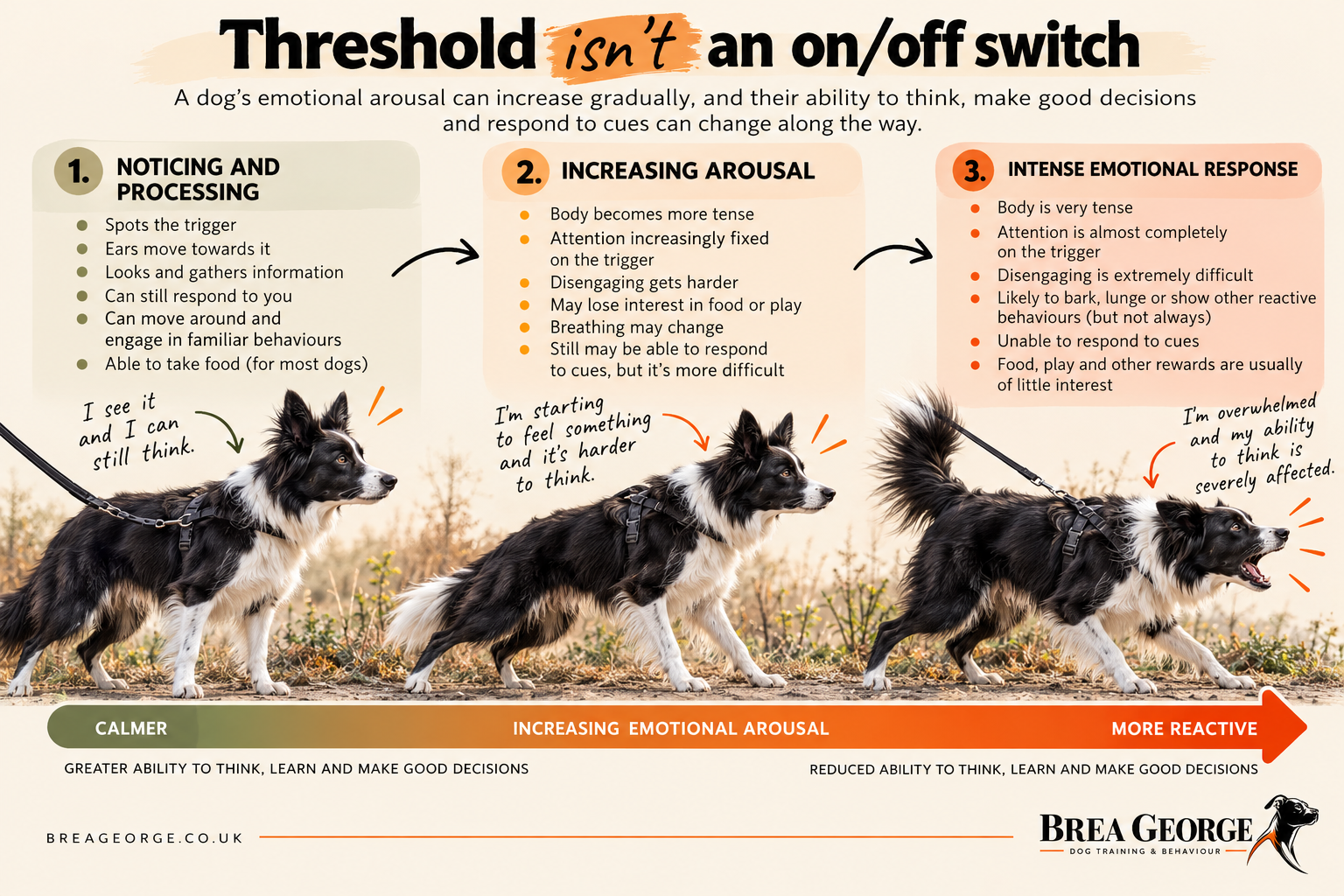
A dog's emotional arousal isn't an on/off switch. As emotions intensify, their ability to disengage, process information and respond to familiar cues can become increasingly difficult. And importantly, barking isn't always the first sign that they're struggling. 🧡
What's actually happening in your dog's brain? 🧠
This is where a little bit of science makes everything much easier to understand.
Your dog's brain is constantly processing information from the world around them.
Some of that information is relatively unimportant.
A leaf moves.
A car drives past.
Somebody closes a door.
Other information carries much greater emotional significance.
Perhaps another dog appears.
Perhaps a stranger approaches.
Perhaps something exciting happens that your dog desperately wants to get involved with.
When the brain identifies something emotionally significant, systems involved in emotional processing, attention and preparing the body to respond become more active.
One of the structures involved in detecting and processing emotionally significant information is the amygdala.
Meanwhile, networks involving the prefrontal cortex contribute to things such as decision-making, attention regulation and inhibiting responses.
These systems aren't completely separate, and they don't simply take turns switching on and off.
They work together.
But as emotional arousal becomes more intense, it can become increasingly difficult for your dog to direct their attention elsewhere, inhibit an immediate response and use previously learned behaviours.
Think about the difference between trying to solve a simple problem when you're relaxed and trying to solve that same problem when you're frightened, overwhelmed or incredibly frustrated.
You haven't suddenly become less intelligent.
But your emotional state can change how effectively you're able to think.
Dogs can experience a similar difficulty.
And this is why I find the relationship between emotion and cognition so important when working with reactive dogs.
Your dog hasn't necessarily forgotten their training
Imagine you've spent weeks teaching your dog to respond to their name.
At home?
Brilliant.
In the garden?
Fantastic.
On a quiet walk?
No problem.
Then another dog appears and suddenly you're standing there saying:
"BUT HE KNOWS THIS!"
And you're probably right.
He does know it.
But knowing a behaviour and being able to access it in a particular emotional state are not the same thing.
As emotional arousal increases, the ability to disengage from a trigger, process your cue and respond appropriately may become much harder.
Repeating the cue louder doesn't necessarily make that cognitive process any easier.
Sometimes it simply adds more information to an already overwhelmed dog.
Your dog isn't necessarily choosing to ignore you. They may genuinely be struggling to process what you're asking.
Emotion and thinking aren't an either/or switch
There's an important distinction here.
You might hear people talk about a dog's emotional brain taking over from their thinking brain.
It's a useful analogy, but neurologically it's an oversimplification.
The brain doesn't have one half that feels and another half that thinks, with only one allowed to operate at a time.
Emotional and cognitive processes constantly interact.
And that's actually incredibly relevant to training.
Because the presence of emotion doesn't mean learning is impossible.
A dog can feel excited and still make decisions.
They can feel frustrated and still learn.
They can feel worried and still process information.
The question is whether the intensity of that emotional response is appropriate for what we're asking them to do.
And this is where my approach to working with reactive dogs becomes particularly important.
I'm not simply interested in whether a dog can remain calm in the presence of a trigger.
I'm interested in whether they can experience that emotion and still use their brain.
Because ultimately, that's what we need them to be able to do in real life.
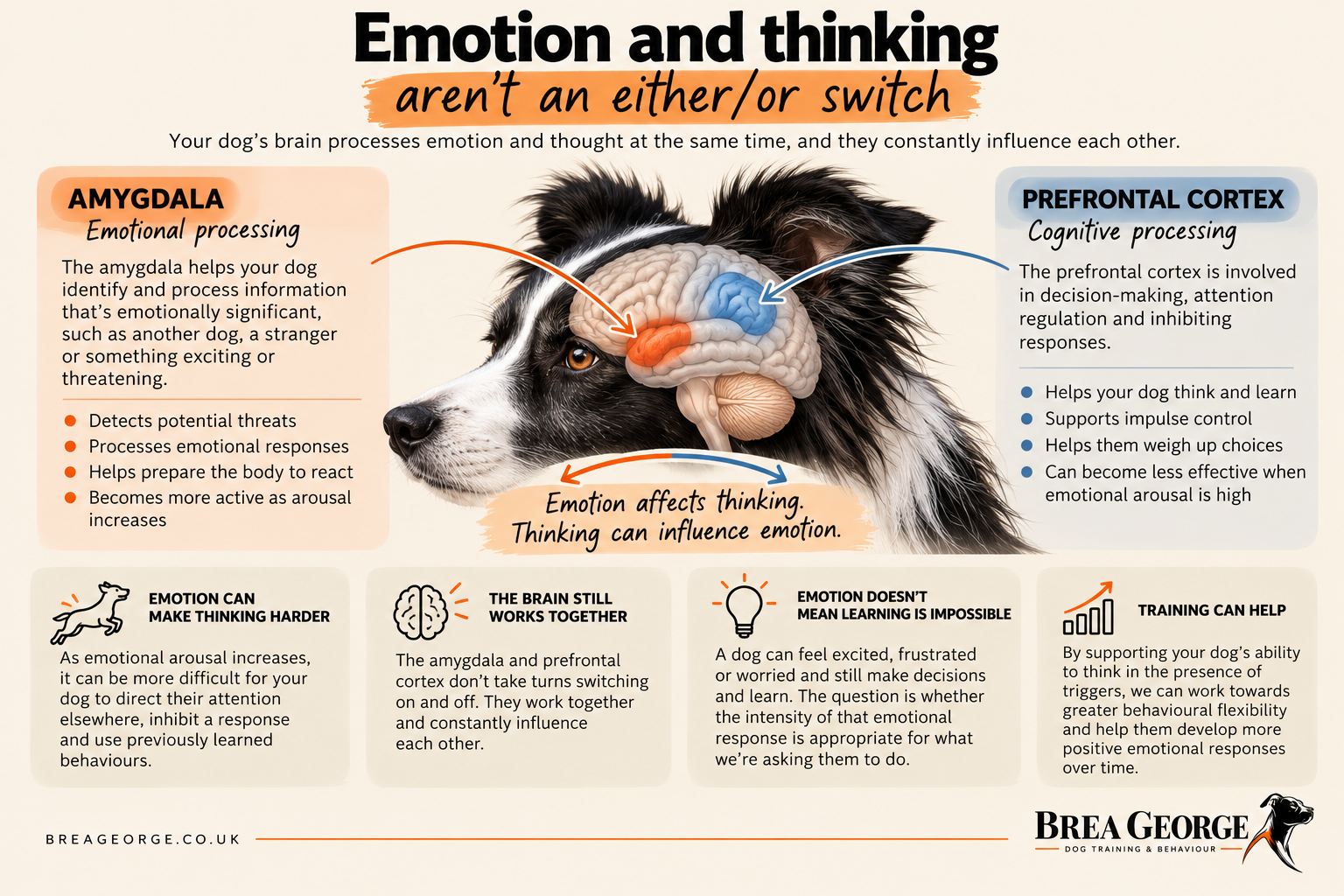
Emotion and thinking aren't two separate switches in your dog's brain. 🧠 They constantly influence one another. While intense emotional arousal can make thinking and decision-making harder, appropriately structured training can help dogs develop the ability to process information and make choices in the presence of triggers. 🧡
Should reactive dogs always be kept under threshold?
You'll often hear the advice:
"Never let your reactive dog go over threshold."
And I understand where that advice comes from.
Repeatedly putting a dog into situations where they're overwhelmed, frightened or unable to cope isn't a productive training strategy.
If a dog is so distressed that they cannot process information or recover, continuing to expose them to that situation can make things worse.
But I don't believe that means our goal should be to prevent reactive dogs from ever experiencing challenging emotions.
Because real life isn't perfectly controlled.
Dogs appear unexpectedly.
People turn corners.
Distances change.
Things happen that we haven't planned for.
And if a dog can only cope when every single aspect of their environment has been carefully arranged to prevent them feeling anything difficult, we haven't necessarily prepared them for those moments.
I don't want a dog who can only cope when nothing challenges them.
I want to help them develop the skills and emotional resilience to cope when life becomes more difficult.
That doesn't mean deliberately overwhelming them.
And it certainly doesn't mean allowing them to repeatedly rehearse intense reactions in the hope they'll eventually get used to things.
It means recognising that carefully managed challenge can be part of learning.
There may be times during professionally guided training when a dog's emotional response becomes more intense than we'd ideally like.
That doesn't automatically mean the session has failed.
But it does mean we need to recognise what's happening and make informed decisions about what happens next.
The important distinction is that we're not deliberately provoking distress for the sake of it.
We're using our understanding of the individual dog to create appropriate learning opportunities.
And knowing how much challenge is appropriate is incredibly individual.
That's where professional assessment and guidance become so important.
The goal isn't to remove emotion. It's to help your dog cope with it.
When I'm working with reactive dogs, I'm interested in much more than whether they can sit quietly while another dog exists somewhere in the distance.
I want to know:
Can they notice something emotionally significant and still process information?
Can they make decisions?
Can they disengage?
Can they respond to familiar information?
And if their emotional response increases, can they recover?
This is why cognitive engagement forms an important part of how I approach reactivity training.
Rather than focusing purely on suppressing the outward reaction, I work on helping dogs develop the ability to think and respond in the presence of things that create an emotional response.
The aim isn't to distract them so completely that they never notice the trigger.
Nor is it to demand obedience while they're overwhelmed.
It's to develop their ability to process information and make different choices in situations they previously found difficult.
And there's an important relationship between cognition and emotion here.
Emotional responses can influence how a dog thinks, but cognitive processes can also influence how they respond emotionally.
By creating opportunities for a dog to engage in appropriate cognitive activity in the presence of a trigger, we can work towards developing greater behavioural flexibility and changing their response over time.
It's not simply about teaching a dog to perform a behaviour while another dog is nearby.
It's about helping them develop a different way of responding to something they previously found difficult.
And over time, successful learning experiences can contribute to changes in both behaviour and emotional responses.
But the way that training is structured matters enormously.
The right challenge for one dog could be completely inappropriate for another.
And recognising that difference is a huge part of working successfully with reactive dogs.
Distance isn't failure
Let's talk about something owners often feel guilty about.
Moving away.
You've taken your dog out.
Another dog appears.
Your dog starts becoming increasingly focused on them.
And you decide to create some distance.
Sometimes owners feel as though they've failed.
They think they should have made their dog stay.
Or that moving away is teaching the dog they can avoid things.
But distance is simply one of the variables that changes how difficult a situation is.
Think about trying to have a conversation with somebody.
It's much easier when they're standing beside you in a quiet room than when they're shouting from across a packed nightclub.
The information might be exactly the same.
The environment changes how difficult it is to process.
Distance from a trigger can work in a similar way.
Increasing distance can reduce the intensity of a situation and make it easier for a dog to disengage, process information and respond.
Sometimes creating distance is exactly what allows learning to continue.
Other times, a carefully planned training session might involve working with a greater level of challenge.
Neither moving closer nor moving further away is automatically the correct decision.
What matters is why you're doing it, what the dog is showing you and whether the experience is helping them learn.
Brea's Tip 🧡
Don't measure progress purely by how close your dog can get to a trigger.
A dog who can get five metres closer but is tense, fixated and struggling to recover hasn't necessarily made more meaningful progress than a dog working comfortably at a greater distance.
Look at the whole picture.
Their emotional response.
Their ability to think.
Their choices.
And their recovery.
Those things tell us far more than distance alone.
Sometimes the most important thing is what happens AFTER the reaction
Imagine two dogs who both bark when another dog appears.
The first dog reacts intensely and remains highly aroused long after the other dog has disappeared.
The second dog barks briefly, then disengages, recovers and returns to their normal behaviour.
They've both barked.
But are they coping in the same way?
Not necessarily.
This is why I pay attention to recovery.
How quickly can the dog return to a more settled state?
Can they process information again?
Can they re-engage with their handler?
Can they continue with what they were doing?
Does their emotional response become less intense over time?
Are they developing greater flexibility in how they respond?
For me, these can be much more meaningful indicators of progress than simply counting how many times a dog barked.
A reaction doesn't automatically mean the training has failed.
But it does give us information about the dog, the situation and what they were capable of at that moment.
And we need to use that information carefully.
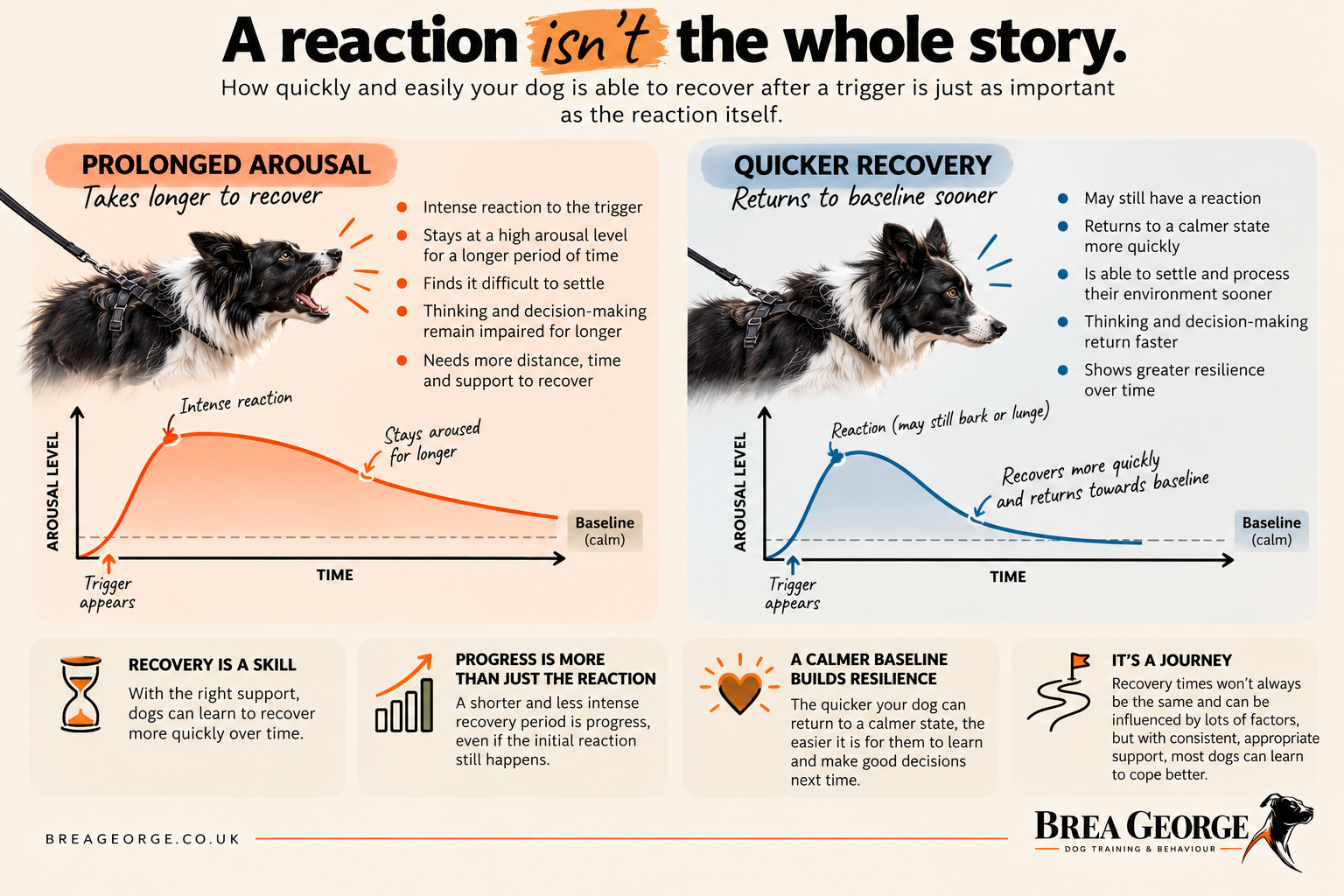
Two dogs can have a very similar reaction to a trigger but recover very differently afterwards. Progress isn't always about eliminating barking or lunging — sometimes it's about reducing the intensity of the response, improving recovery and helping the dog regain the ability to think and make decisions. 🧡
Your dog's threshold can change from day to day
Another important thing to understand is that threshold isn't fixed.
The dog who coped beautifully with something yesterday might find that same situation much harder today.
Why?
Because their ability to cope can be influenced by lots of things.
Sleep and fatigue.
Pain or physical discomfort.
Previous stressful experiences.
Excitement and frustration.
The environment.
The intensity and unpredictability of the trigger.
How much has already happened that day.
How quickly they've recovered from previous experiences.
This is one reason a dog might appear to react "out of nowhere" to something they normally manage perfectly well.
It's also where the concept of trigger stacking becomes particularly useful.
Several smaller experiences can accumulate, leaving a dog with less capacity to cope with something that would normally be manageable.
So rather than assuming:
"He was fine with this yesterday, so he should be fine today."
I'd rather ask:
"What's different about what he's experiencing today?"
Because the dog standing in front of you today is the one we need to train.
Not the dog you had yesterday.
Knowing when to push and when to back off
This is probably one of the most important distinctions in reactivity training.
If we never introduce appropriate challenges, we may limit the opportunities a dog has to develop new coping skills.
But if we increase the difficulty too quickly, we risk overwhelming them and reinforcing the very responses we're trying to change.
Successful training isn't simply about making everything easier.
It's about knowing when the dog is ready for something harder — and recognising when they need more support.
That judgement isn't based on one universal rule.
It depends on the individual dog, their emotional response, their behaviour, their learning history, the environment and how they're recovering.
And it's why I wouldn't recommend that owners deliberately push a reactive dog beyond threshold based on something they've read online.
There is a significant difference between a carefully structured training session with an experienced professional and repeatedly exposing a dog to situations they cannot cope with.
The goal isn't to provoke a reaction.
The goal is to create learning opportunities that help the dog become more capable of coping.
Sometimes that means increasing the challenge.
Sometimes it means backing off.
And sometimes the most productive decision is to end the session altogether.
Knowing the difference matters.
Not every reaction means the same thing
I think this is worth remembering:
Not every dog who barks is over threshold.
Not every dog who is quiet is coping.
Not every reaction means you've pushed too far.
And not every dog who appears to be managing a situation is genuinely comfortable.
Threshold is a useful concept, but it isn't a diagnosis or a precise measurement of what's happening inside your dog's brain.
We can't look at a dog and know exactly what they're feeling.
What we can do is observe their behaviour, understand the context, consider their learning history and use that information to make informed training decisions.
And if a dog's behaviour changes suddenly or dramatically, we should also consider whether pain or another health issue may be contributing.
Behaviour is information.
The skill is learning how to interpret it.
It's not about keeping your dog in a bubble
I don't want reactive dogs spending their entire lives avoiding anything that might produce an emotional response.
But equally, I don't want them repeatedly placed into situations where they're overwhelmed and unable to cope.
I want them to learn that they can experience emotion and still have choices.
That they can notice something difficult.
Process information.
Develop new responses.
And recover when things don't go perfectly.
Because the aim isn't to create a dog who never experiences frustration, excitement, worry or uncertainty.
Those emotions are part of life.
The aim is to help them become better equipped to cope with them.
And that's why understanding threshold matters.
Not because there's an invisible line we must never cross.
But because it helps us understand what our dog is capable of in that moment — and how we can help them become capable of more.
Understanding your dog's behaviour is only the beginning
Recognising when your dog is struggling is one thing.
Knowing when to increase the challenge, when to create distance, how to structure learning around triggers and how to help your dog develop greater emotional resilience is where individual coaching makes a difference.
My approach to Reactivity Coaching is built around understanding the dog in front of me — not following a one-size-fits-all training formula.
Because the goal isn't simply to avoid reactions.
It's to help your dog develop the skills to cope with real life. 🧡