

Because stopping the noise starts with understanding why it's happening.
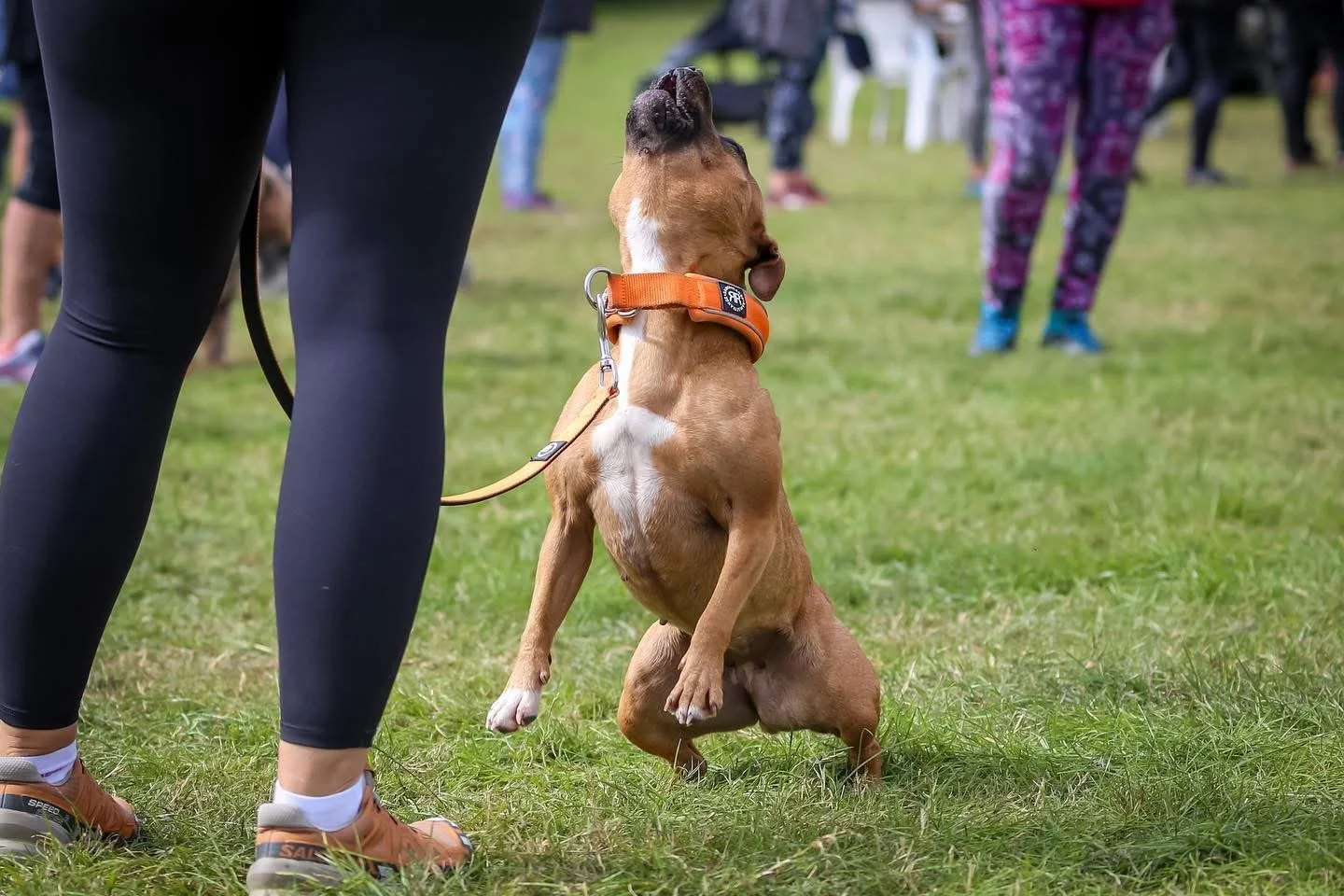
There is quite clearly something VERY important to say. 😂 But before we try to stop the barking, we need to understand why it's happening.
“How do I stop my dog barking?”
It's one of the most common dog training questions.
Barking at the window.
Barking at other dogs.
Barking when someone knocks at the door.
Barking because you've stopped throwing the ball.
Barking when you leave.
Barking at 11pm at something you are absolutely convinced does not exist.
And when you've listened to it for what feels like the 400th time that day, it's completely understandable that your first question is:
How do I make it stop?
But that's usually not the first question I want to answer.
I want to know:
Why is your dog barking?
Because barking is communication.
A frightened dog can bark.
An excited dog can bark.
A frustrated dog can bark.
A dog who wants your attention can bark.
A dog who has spotted someone walking past the window can bark.
A dog who is struggling with being left alone can bark.
The behaviour might look the same. The reason behind it can be completely different.
And if we don't understand what's driving the barking, we can very easily choose a solution that doesn't solve the actual problem.
Barking is normal dog behaviour
Before we go any further, I think this is worth saying:
Dogs bark.
It's a completely normal part of being a dog.
That doesn't mean you have to happily live with six hours of barking at the front window every day, and it doesn't mean excessive barking can't be a sign that something needs addressing.
But the goal shouldn't necessarily be to create a dog who never makes a sound.
Some dogs are naturally more vocal than others. Genetics, breed, personality, learning history and environment can all influence how readily a dog uses their voice.
And sometimes barking is actually very useful information.
The problem is that humans tend to focus on the bit that's annoying us:
THE NOISE.
Whereas from a training perspective, I'm much more interested in what's happening underneath it.
What job is the barking doing?
This is where things get interesting.
Two dogs can both bark at another dog and be experiencing completely different things.
One might be thinking:
PLEASE COME OVER HERE, I WANT TO SAY HELLO.
Another might be thinking:
PLEASE DO NOT COME ANY CLOSER.
They both bark.
But one may be driven by frustration because they can't access something they want, while the other may be trying to create distance from something they're worried about.
If I simply tell you to “stop your dog barking at other dogs”, I'm ignoring the most important part of the problem.
Why are they doing it?
So rather than looking at barking as one behaviour with one solution, let's look at some of the reasons dogs bark.
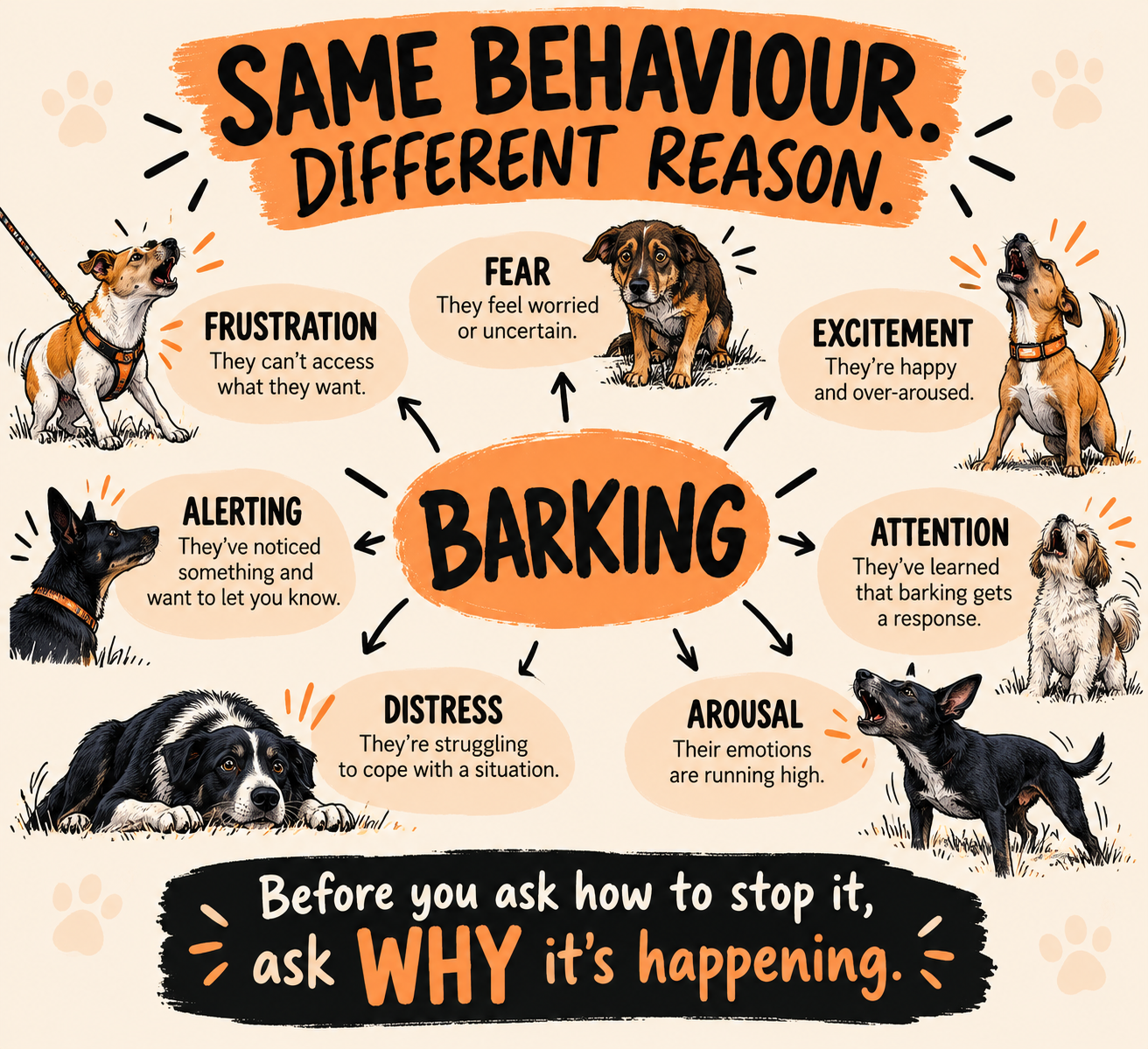
The same behaviour can have very different reasons behind it. Before we decide how to change the barking, we need to understand what's driving it.
🚨 “Something's there!” — alert barking
The delivery driver arrives.
Someone walks past the house.
A car door closes outside.
Your neighbour has committed the terrible crime of putting their bins out.
WOOF WOOF WOOF WOOF.
Alert barking is exactly what it sounds like: your dog has noticed something and is announcing it.
For some dogs, that's a very natural response.
The interesting bit is what happens next.
Imagine your dog sees somebody walking past the window.
They bark.
The person keeps walking and disappears.
From your dog's perspective:
I barked → the person went away.
Now, obviously that person was going to continue walking regardless.
Your dog doesn't know that.
They may simply learn that barking at things outside is a pretty successful strategy.
And every time they practise it, they're getting another repetition.
😟 “I need this to go away.” — fear and worry
Barking can also be about creating distance.
A dog might bark at another dog, a stranger, a child, a visitor or something unfamiliar because they're uncomfortable.
Sometimes this barking gets described as the dog being “aggressive”, “dominant” or “protective”.
But if we look at the whole dog, we may see something very different.
Perhaps they're saying:
I'm not comfortable with this. Please stay away from me.
That's important, because if fear is driving the barking, simply punishing the bark doesn't address the reason it happened.
The dog may become quieter.
But that doesn't necessarily mean they feel safer.
And that distinction matters.
🤬 “LET ME GET TO IT.” — frustration
Then we have the dog who actually desperately wants to get closer.
They see another dog.
Or a person.
Or the agility ring.
Or their favourite friend.
They want to GO.
The lead says no.
Their little brain says:
THIS IS AN OUTRAGE.
And out comes the barking.
Frustration barking can look surprisingly dramatic.
Pulling, lunging, spinning and barking can make a dog look frightening from the other end of the lead, even when the motivation behind it is wanting to get closer rather than create distance.
Again:
Same visible behaviour. Completely different emotion underneath it.
And potentially a completely different training plan.
🤩 “THIS IS THE BEST THING THAT HAS EVER HAPPENED.” — excitement and arousal
Some dogs bark when they're excited.
Playing.
Training.
Getting ready for a walk.
Waiting for a toy to be thrown.
Watching another dog run.
Getting out of the car somewhere exciting.
And sometimes what begins as excitement tips over into very high arousal, where thinking becomes increasingly difficult.
If you've ever stood holding a lead while your dog appears to be shouting:
THROW THE BALL THROW THE BALL THROW THE BALL THROW THE BALL
you'll know exactly what I mean.
In those situations, I don't just want to think about stopping the barking.
I'm interested in the dog's overall arousal levels and their ability to regulate themselves around exciting things.
👀 “Hey. HEY. HEYYYY.” — attention and learned barking
Dogs are excellent at working out what gets results.
Imagine your dog walks over while you're working.
They bark.
You look at them.
They bark again.
You say:
“WHAT?”
They continue.
Eventually you get up and let them into the garden.
From the dog's perspective:
Excellent. That worked.
It doesn't matter that you were annoyed.
It doesn't matter that you told them to stop five times first.
The barking ultimately produced something useful.
And if a behaviour consistently works, there's a pretty good reason to try it again.
That doesn't mean we should start completely ignoring every barking dog — because, as we've already established, barking can happen for lots of reasons.
But it does mean we need to look at what your dog has learned happens when they bark.
What happens AFTER your dog barks?
This is one of the most useful questions you can ask.
We often focus on what happened immediately before a behaviour:
The dog saw another dog → they barked.
But I also want to know what happened afterwards.
Dog barks at window → person disappears.
Dog barks at owner → toy gets thrown.
Dog barks at back door → door opens.
Dog barks at another dog → other dog moves away.
Dog barks while owner is making dinner → food eventually appears.
This doesn't automatically mean you should refuse to give your dog what they want.
If your dog is frightened and barking because another dog is too close, moving them away may be exactly the right thing to do.
We're not trying to win some bizarre battle of wills where the dog must never discover that communication works.
We're asking:
What was my dog trying to achieve — and what are they learning from what happened next?
That's a much more useful question.
Brea's Tip 🧡
When barking happens, try looking at the whole picture:
What happened before it?
What was my dog doing and feeling?
What happened afterwards?
Patterns often become much easier to spot when we stop looking at the bark in isolation.
Why does my dog bark at the window?
Window barking deserves its own mention because it can become incredibly well practised.
Your dog sees someone.
They rush to the window.
They bark.
The person disappears.
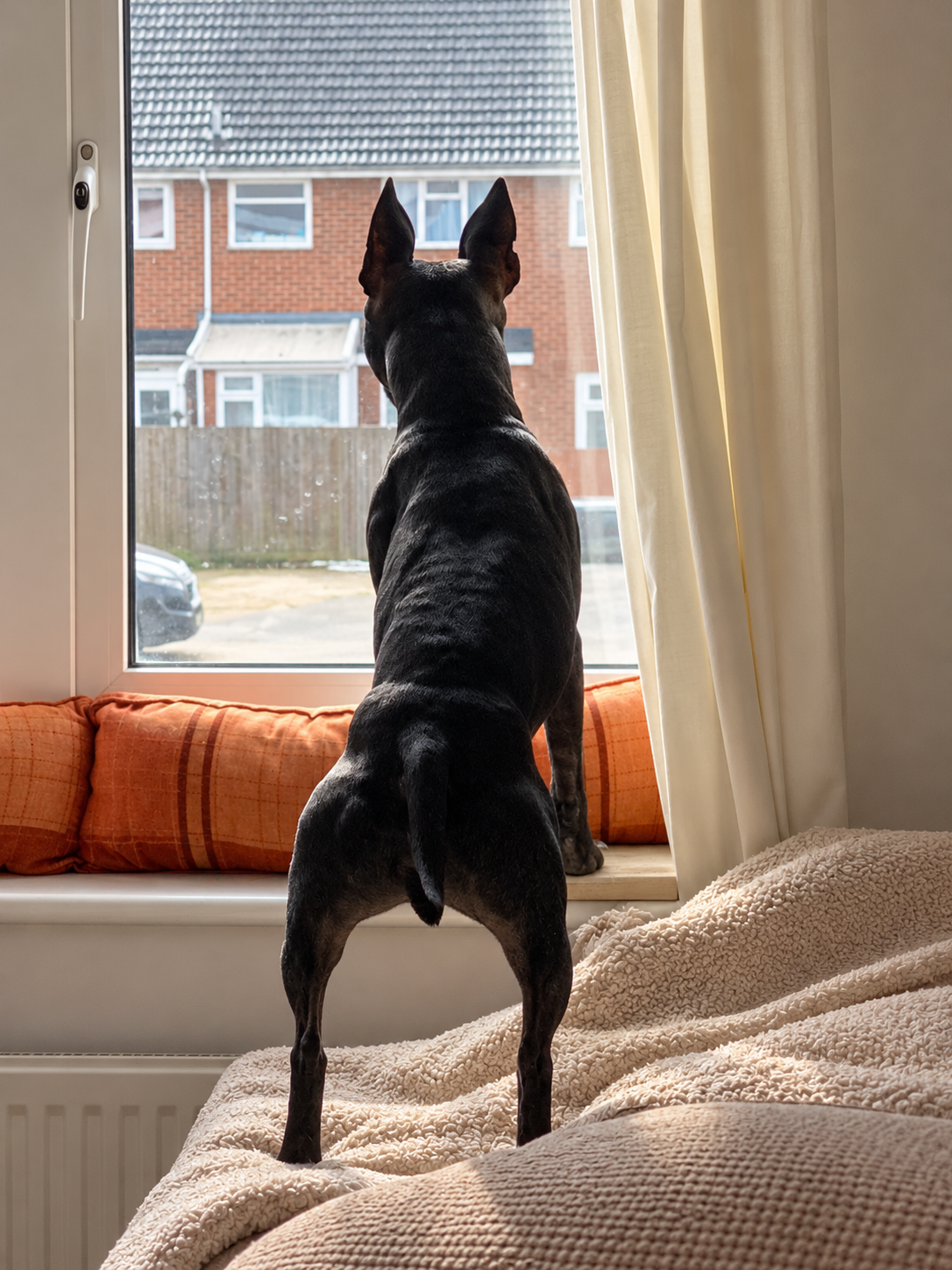
The neighbourhood watch shift has begun. 😂 Window watching can give dogs hundreds of opportunities to practise reacting to what's happening outside.
Repeat that five, ten, twenty times a day and you've got a behaviour with a LOT of practice behind it.
And remember:
Practice makes permanent. Not perfect. Permanent.
So one of the first things I might suggest isn't even technically “training”.
It might be stopping your dog spending six hours a day policing the neighbourhood.
Frosted window film.
Closing the curtains.
Moving furniture away from the window.
Using a gate to restrict access.
Changing where your dog's bed is positioned.
That's management.
And management isn't cheating.
Sometimes preventing twenty rehearsals of a behaviour is far more useful than trying to train your way out of the twenty-first.
Why does my dog bark at other dogs?
This is another enormous one.
And unfortunately:
“My dog barks at other dogs” doesn't tell me enough.
I want to know:
What does their body look like?
How far away is the other dog when it starts?
Does it happen on lead and off lead?
What happens if the other dog approaches?
What happens if the other dog moves away?
Can your dog disengage?
Does your dog want interaction?
Do they have a history of frightening experiences?
Is it worse in certain environments?
Is it frustration?
Fear?
Excitement?
Over-arousal?
A mixture?
This is exactly why copying somebody else's training plan from a 30-second social media video can be problematic.
Their dog may be barking.
Your dog may be barking.
That doesn't mean they're barking for the same reason.
Why does my dog bark when I leave?
This is one I would be particularly careful with.
If your dog barks or howls when left alone, don't automatically assume they're being demanding, naughty or trying to get you to come back.
For some dogs, vocalisation when alone can be part of genuine separation-related distress.
And that's something I want to understand rather than punish.
Video can be incredibly useful here because it lets us see what actually happens after you leave.
Do they bark briefly and then settle?
Do they pace?
Pant?
Watch the door?
Howl?
Scratch at exits?
Can they eat?
Do they settle at all?
The barking is only one piece of the picture.
If your dog is genuinely distressed when left alone, the goal isn't simply to make the house quieter.
It's helping them feel safer when you're gone.
“My dog barks at absolutely everything”
Sometimes there isn't one obvious trigger.
You might have a dog who seems to spend their entire life on neighbourhood watch.
A noise outside.
A bird in the garden.
Another dog.
A door closing.
Something moving.
Something not moving.
A suspicious-looking leaf.
In those cases I start looking at the bigger picture.
How much rest are they getting?
How much time do they spend watching the world?
Are they generally anxious?
Are they easily startled?
Are their needs being met?
Do they have appropriate outlets?
Are they constantly highly aroused?
Have they simply had an enormous amount of practice barking?
Because sometimes trying to address each individual bark misses the bigger issue:
This dog may be finding it really difficult to switch off.
Quiet doesn't always mean comfortable
This might be the most important part of this article.
Because when barking is causing a problem, it's completely understandable to want it to stop.
But:
Stopping the barking and solving the problem aren't necessarily the same thing.
Imagine a dog barking because they're frightened of somebody approaching.
If we introduce something unpleasant every time they bark, we may eventually suppress the barking.
Great.
They're quiet.
But have we changed how they feel about the approaching person?
Maybe not.
They may still be frightened.
We've just made expressing that fear less safe.
And that matters.
Quiet ≠ comfortable.
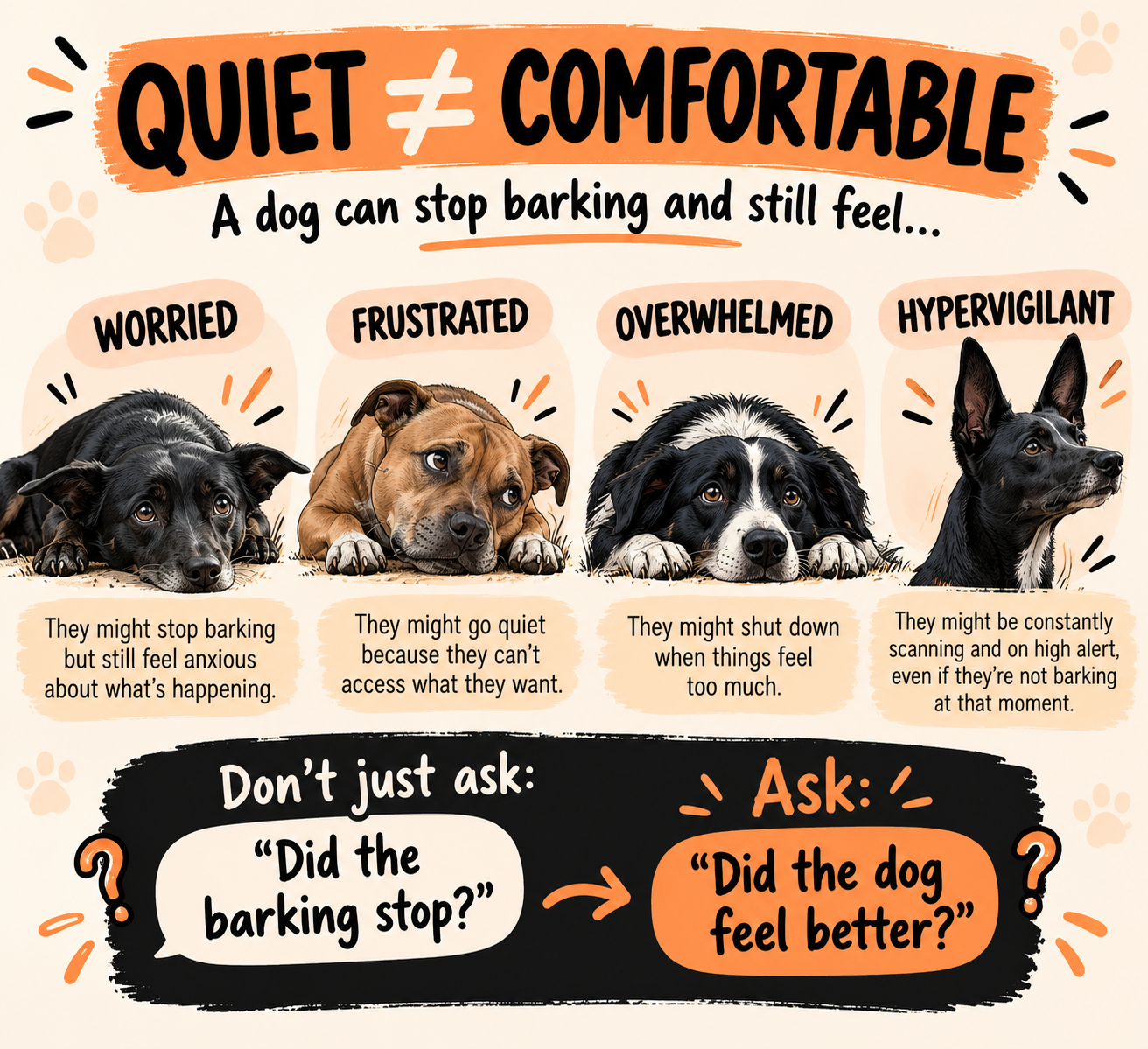
Stopping the barking doesn't necessarily mean we've changed how the dog feels. The goal isn't simply a quieter dog — it's a dog who feels better. 🧡
I don't just want a dog who isn't making noise.
I want to understand why they felt the need to make the noise in the first place.
That's why I'm not interested in simply startling, spraying, shouting at or otherwise punishing barking out of a dog.
Stopping the communication doesn't necessarily change the emotion underneath it.
So... how DO I stop my dog barking?
Here comes everybody's favourite dog-training answer:
It depends.
Because the training plan depends on the reason for the behaviour.
A dog barking because they're frightened may need more distance and carefully planned work to change how they feel about the trigger.
A dog barking through frustration may need help learning how to regulate themselves and disengage when they can't access something immediately.
A dog barking for attention may need to learn another way of asking for what they need — while we also look at what has historically reinforced the barking.
A dog barking at the window may need their environment changed so they aren't rehearsing it all day.
A dog barking through excitement may need help bringing their arousal levels down rather than simply being told to be quiet.
A dog barking when left alone may need support with the underlying distress.
There isn't one universal “stop barking” exercise because there isn't one universal reason dogs bark.
And that's exactly why understanding the behaviour has to come first.
Brea's Tip 🧡
Before asking:
“How do I stop this behaviour?”
try asking:
“What would I like my dog to do instead?”
It's much easier to train towards something than spend your entire life telling your dog what not to do.
Management isn't giving in
This comes up constantly in dog training.
Close the curtains?
“But then he hasn't learned not to bark.”
Move further away from another dog?
“But then she's won.”
Use a baby gate when visitors arrive?
“But I want him to learn.”
Put your dog back on a long line?
“But that's going backwards.”
No.
Management creates opportunities for learning.
If your dog practises exploding at the window thirty times every day, that's thirty repetitions you're competing with.
If we prevent twenty-eight of those and deliberately train around the other two?
Now we've got something much more useful to work with.
Management doesn't have to be forever.
Sometimes it's simply what stops the problem getting stronger while we work on changing it.
What about barking because my dog is bored?
Yes, dogs whose physical, mental or behavioural needs aren't being met may find their own things to do.
And sometimes those things are noisy.
But I'd be careful about jumping straight to:
“Your dog needs more exercise.”
Because more isn't always better.
A dog who already struggles to switch off doesn't necessarily need another two hours of high-arousal activity added to their day.
Look at the whole picture.
Appropriate exercise.
Opportunities to sniff and explore.
Sleep.
Chewing.
Training.
Breed-appropriate outlets.
Social needs.
Time to decompress.
And crucially:
the ability to do absolutely nothing sometimes.
Meeting a dog's needs and constantly keeping a dog entertained are not the same thing.
Some dogs are just more vocal
Genetics matter too.
We've selectively bred dogs for generations to perform different jobs, and vocal behaviour can be part of that picture.
Some dogs are naturally more likely to alert to changes in their environment.
Some are more environmentally sensitive.
Some have been bred to use their voice while working.
And individuals within the same breed can still be completely different.
So if you've chosen a naturally vocal dog and your ultimate training goal is:
“I would like this dog to never bark.”
...we may need to have a small chat about expectations.
We can absolutely work on excessive or problematic barking.
But good training should still take into account the dog in front of us.
Reality Check
If your dog's barking has suddenly changed, particularly if there's no obvious explanation, don't automatically assume it's a training problem.
A dog who has suddenly started barking at night, become unusually vocal, seems more easily startled or is showing other changes in behaviour may need a veterinary check.
Pain, discomfort, changes in hearing or vision, cognitive changes and other medical issues can all affect behaviour.
Behaviour is information.
And sometimes the information is telling us to look beyond training.
Your dog isn't barking for no reason
I know barking can be incredibly frustrating.
Particularly when you're living with it every day.
But before we focus entirely on making the noise disappear, I want to understand the dog producing it.
So next time your dog starts barking, before you ask:
“How do I stop this?”
try asking:
“What are they trying to tell me?”
What happened before it?
What are they trying to achieve?
How are they feeling?
What happens afterwards?
What have they practised?
And what could we help them do instead?
Because once we understand the why, we can start changing the behaviour rather than simply trying to silence it.
Your dog isn't barking for no reason.
We just haven't necessarily worked out the reason yet. 🧡
Need some help figuring out the why?
If your dog's barking is becoming difficult to manage, you don't have to work it all out on your own.
We'll look at what's happening before the barking, what's driving it, what your dog is communicating and what they're learning from what happens afterwards — then build a training plan around your dog and your real life.
Because the answer isn't always “stop the barking”.
Sometimes we need to understand what they're trying to tell us first. 🧡