

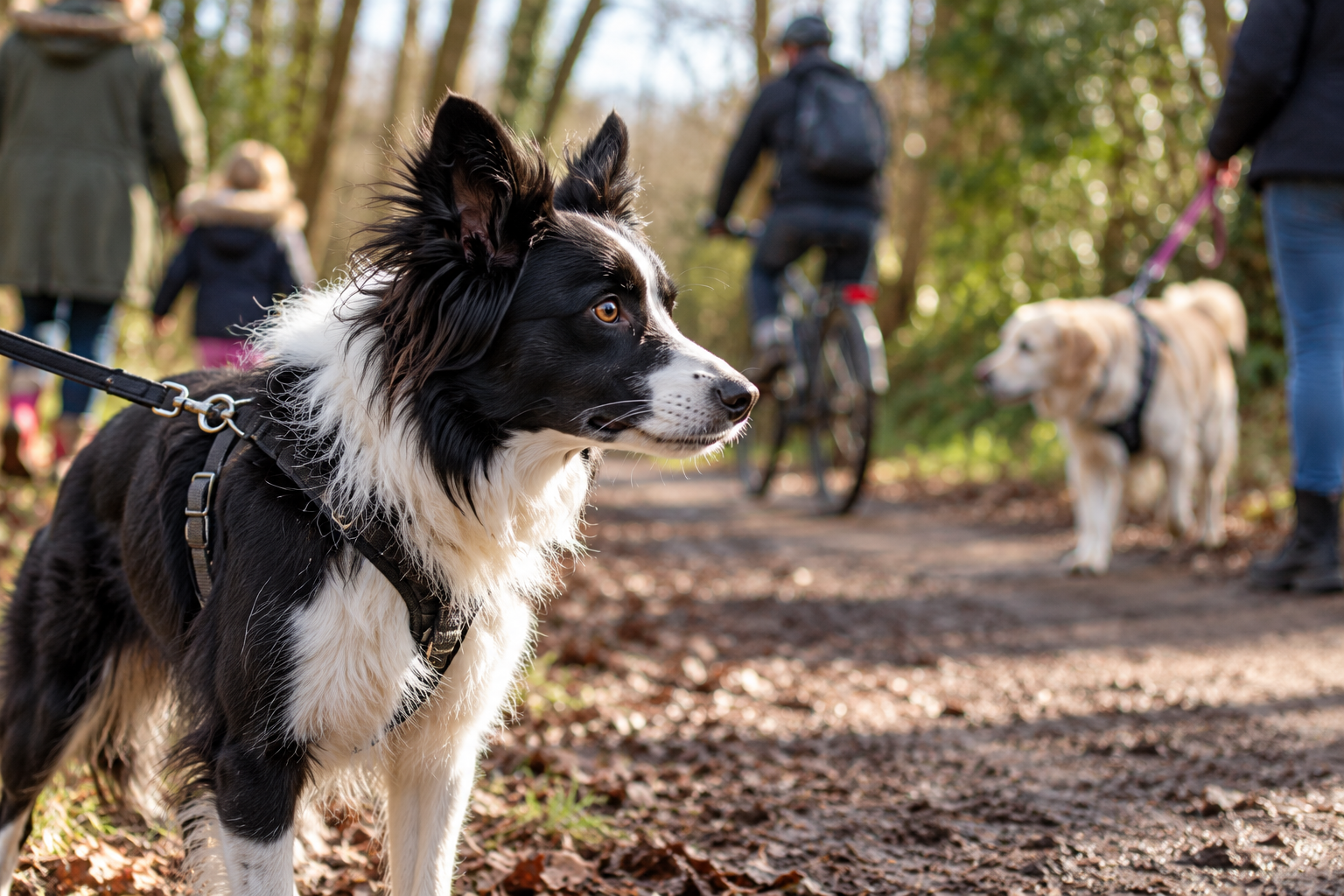
Sometimes it's not the last thing that causes the reaction — it's everything that's happened beforehand. 🧡 A busy environment, exciting experiences and challenging encounters can all influence how much your dog is able to cope with.
Your dog was absolutely fine with that yesterday. So why have they completely lost their mind today?
You've taken your dog for a walk.
They've walked past three dogs without a problem.
They've ignored the cyclist.
They've coped with the noisy traffic.
You're feeling pretty pleased with how things are going.
And then another dog appears.
BARK BARK BARK BARK BARK.
Oh, for goodness' sake.
But here's the interesting question.
Was it really that last dog that caused the reaction?
Or was it everything that happened before that dog appeared?
Welcome to the wonderful world of trigger stacking.
And once you understand it, a lot of those seemingly unpredictable reactions start to make much more sense.
What is trigger stacking?
Trigger stacking is a term we use to describe what happens when multiple emotionally significant experiences occur close together, before a dog has had sufficient opportunity to recover.
Each experience can contribute to their overall level of arousal or stress.
And while your dog might cope perfectly well with each situation individually, the combined effect can make the next challenge much harder to manage.
Think of it like carrying shopping bags.
One bag?
Absolutely fine.
Two bags?
Still manageable.
Three bags, your handbag, your keys, a toddler who's decided their legs no longer work and somebody asking you a question?
SOMEBODY IS GOING TO HAVE TO OPEN THE FRONT DOOR.
None of those things was necessarily impossible on its own.
But together?
You've reached your limit.
Dogs can experience something similar.
And the important thing to understand is that trigger stacking isn't necessarily about one enormous stressful event.
Sometimes it's lots of smaller things that gradually add up.
It's not just the scary stuff
When people hear the word trigger, they often think of something frightening.
Another dog.
A stranger.
A loud noise.
But emotional arousal isn't limited to fear.
Excitement, frustration and anticipation can also contribute to a dog's overall arousal.
Imagine your dog's morning has looked something like this:
The doorbell rang and they got incredibly excited.
They watched a cat through the window.
They had a frustrating encounter with another dog on their walk.
They played an intense game of fetch.
They struggled to settle because the house was busy.
Individually, none of those experiences necessarily looks particularly significant.
But by the afternoon, your dog may already be carrying a much higher level of arousal than usual.
Then something happens that they'd normally cope with.
And suddenly?
BIG reaction.
It's easy to assume that final event must have been particularly upsetting.
But sometimes it's simply the thing that arrived when your dog had very little capacity left to cope.
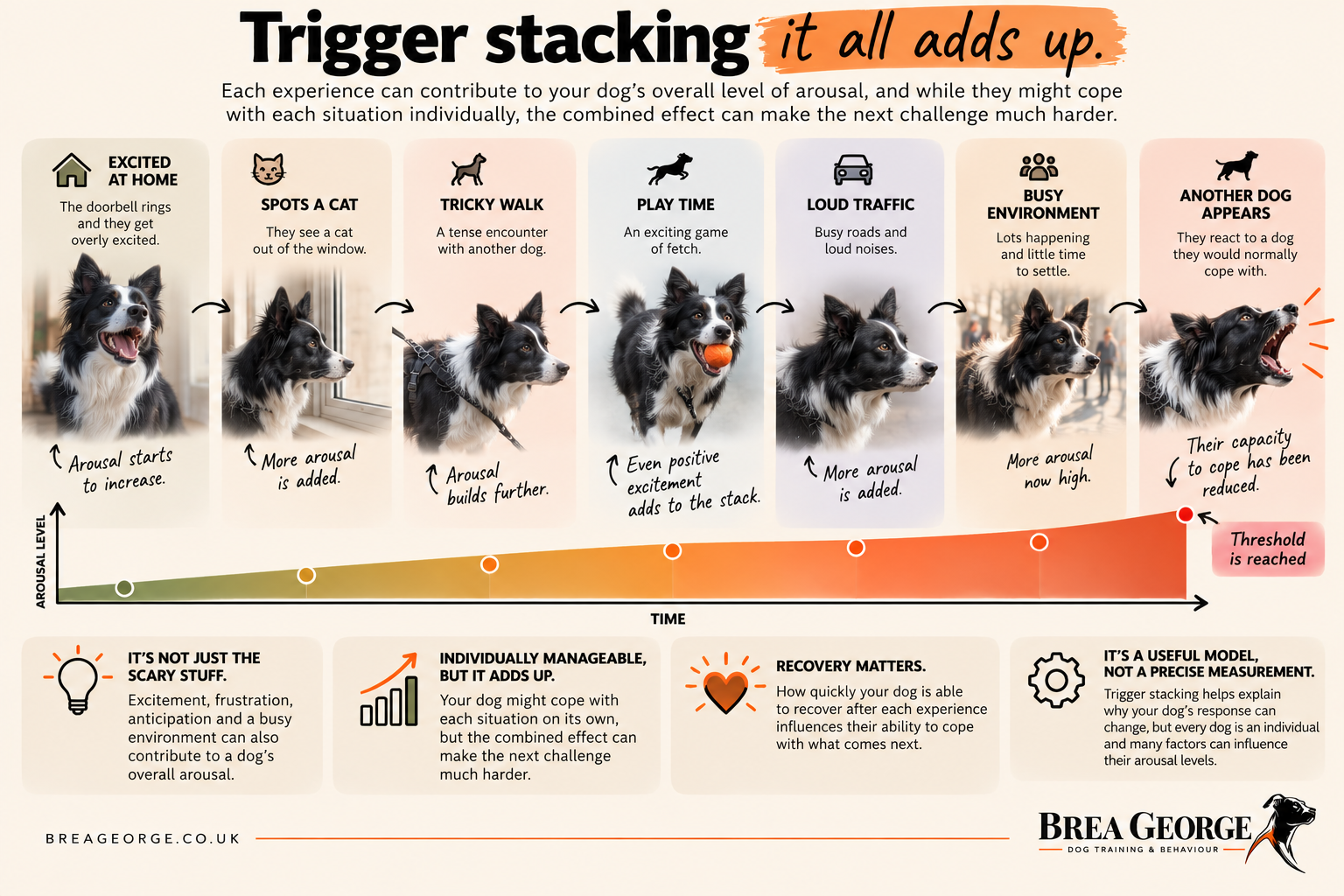
It's not always the last thing that causes the reaction! Multiple experiences throughout the day — including excitement, frustration and stressful encounters — can influence your dog's overall arousal and ability to cope. Sometimes that final trigger is simply one challenge too many. 🧡
What's happening inside your dog's body? 🧠
When a dog experiences something exciting, frightening or frustrating, their body may activate systems involved in responding to that situation.
The sympathetic nervous system helps prepare the body for action, influencing things such as heart rate, breathing and alertness.
Depending on the experience, the body's hormonal stress-response systems may also become involved, including the release of hormones such as adrenaline and cortisol.
These responses are normal.
They're part of how animals respond to challenges.
But the body doesn't necessarily return to its previous state the instant the event ends.
And different physiological responses operate on different timescales.
For example, adrenaline-related effects can change relatively quickly, while other stress-related processes may last longer.
That doesn't mean every exciting event produces a predictable amount of cortisol, or that stress hormones simply accumulate like water filling a bucket.
Trigger stacking is a useful behavioural model, not a precise measurement of how much stress is inside your dog.
What matters practically is that previous experiences can influence how prepared your dog is to cope with the next one.
And that brings us back to the relationship between emotion and cognition.
As emotional arousal increases, your dog's attention, impulse control and ability to access familiar behaviours can become more difficult.
Which means the dog who could calmly disengage from another dog at 9am might struggle to do exactly the same thing at 3pm.
Same dog. Same training. Different emotional state.
Why does my dog suddenly react to something they normally ignore?
This is where owners often become frustrated.
Because the reaction appears completely inconsistent.
One day your dog walks past another dog beautifully.
The next day they bark and lunge at a dog much further away.
And it's tempting to think:
"We've gone backwards."
But behaviour doesn't happen in isolation.
Perhaps your dog slept badly.
Perhaps there was building work next door.
Perhaps they'd already had several difficult encounters.
Perhaps they're uncomfortable or in pain.
Perhaps today's environment is simply more challenging.
Or perhaps they're still recovering from something that happened earlier.
All of those things can influence their ability to cope.
And importantly, not every unexpected reaction is caused by trigger stacking.
We also need to consider things like changes in the environment, learning history, physical health and the individual trigger itself.
The point isn't to blame every reaction on accumulated stress.
It's to recognise that the last thing your dog reacted to might not tell us the whole story.
Your dog's threshold isn't fixed
In our article about Why Reactive Dogs Stop Listening, we explored how emotional arousal can affect a dog's ability to process information and respond to familiar cues.
Trigger stacking helps explain why that ability can change throughout the day.
A situation that was manageable earlier might become much more difficult after several emotionally significant experiences.
And this is why I don't think it's particularly helpful to treat threshold as a fixed distance from another dog.
You might have a dog who can comfortably work around another dog at ten metres on one occasion.
On another day, twenty metres might be challenging.
That doesn't automatically mean your training has failed.
It means the dog in front of you is responding to the circumstances they're experiencing now.
And good training needs to account for that.
Does that mean we should avoid anything that excites or stresses our dogs?
No.
And this is where I think the conversation around trigger stacking can become a little too simplistic.
If we interpret it as meaning that every emotionally significant experience is something to avoid, we risk creating a life where we're constantly trying to prevent dogs from feeling anything at all.
But dogs are going to experience excitement.
They're going to experience frustration.
They're going to encounter things they find difficult.
And developing the ability to cope with those experiences is part of what training should help them achieve.
The aim isn't to eliminate emotional arousal.
It's to understand how different experiences affect the individual dog, and to recognise when they're coping well and when they might need additional support.
Sometimes that means allowing time to recover.
Sometimes it means changing the environment.
And sometimes, within a professionally structured training programme, it means introducing an appropriate level of challenge so the dog can develop greater resilience and coping skills.
There's a significant difference between helping a dog learn to cope with manageable challenges and repeatedly overwhelming them.
Knowing where that distinction lies is an important part of effective behaviour work.
Recovery matters
One of the things I pay particular attention to when working with reactive dogs is how they recover after something emotionally significant happens.
Because two dogs can experience the same event and respond very differently afterwards.
One might become excited, then return to their usual behaviour within a short period.
Another might remain highly aroused, vigilant or unsettled long after the event has passed.
And that difference can influence how they cope with whatever happens next.
Recovery is part of the bigger picture.
It's also one of the reasons that simply counting reactions doesn't always tell us whether training is progressing.
A dog who still reacts occasionally but recovers more quickly may be developing valuable coping skills.
Equally, a dog who appears quiet but remains tense and hypervigilant may still be finding the situation extremely difficult.
We need to look beyond the obvious behaviour.
What can you do if you think your dog is experiencing trigger stacking?
The first thing I'd encourage you to do is become curious.
Rather than focusing entirely on the last thing your dog reacted to, think about what happened earlier.
Was the day unusually busy?
Had they encountered several difficult situations?
Had they slept well?
Were they already more excited, frustrated or vigilant than usual?
And how quickly did they recover from previous experiences?
You don't need to start documenting every second of your dog's life.
But noticing patterns can be incredibly useful.
You might discover that your dog struggles more after busy mornings.
Or that certain combinations of experiences are particularly challenging.
Or that they need more recovery time after specific activities than you'd previously realised.
That information helps us make better training decisions.
It doesn't mean your dog should spend the rest of their life avoiding anything difficult.
It means we can start understanding what affects their ability to cope.
And if your dog's reactions suddenly become much more intense or unpredictable, particularly alongside other changes in behaviour, it's worth speaking to your vet to rule out pain or other medical factors.
Sometimes it's not the last straw. It's all the straws before it.
I think this is one of the most useful ways to look at trigger stacking.
When your dog suddenly reacts to something they've previously managed, it doesn't automatically mean they've forgotten their training.
It doesn't necessarily mean they've become more reactive.
And it certainly doesn't mean they're deliberately being difficult.
It might mean that the demands of the day have exceeded what they were capable of coping with at that moment.
But the long-term goal isn't simply to remove all those demands.
It's to help your dog develop the skills, flexibility and resilience to manage more of what real life throws at them.
Because training should be built around the dog in front of you.
And sometimes understanding what happened before the reaction is just as important as understanding the reaction itself.
Is your dog's reactivity difficult to predict?
If your dog seems fine one minute and overwhelmed the next, there's often more going on than the last trigger they encountered.
In Behaviour Coaching, we look at the bigger picture — your dog's emotional responses, learning history, environment, recovery and ability to cope with different challenges.
Then we build a training plan around your individual dog, rather than simply trying to stop the barking or avoid every difficult situation.
Because understanding why your dog reacts is the first step towards helping them respond differently.