Because learning to do nothing is a skill too.
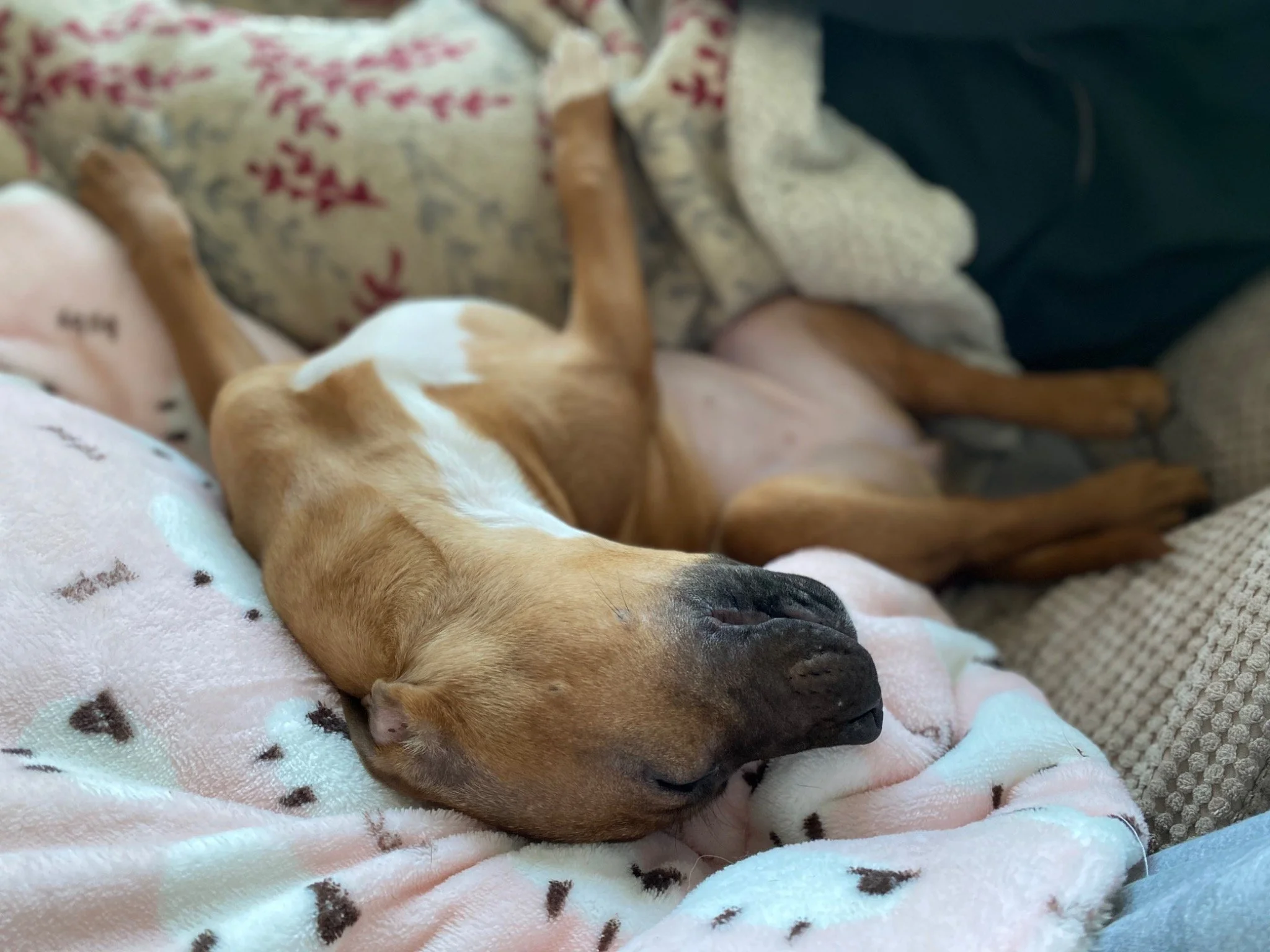
Sometimes the most useful thing your puppy can learn is that absolutely nothing is happening right now. 🧡
There's a lot of pressure to keep puppies busy.
Training sessions. Enrichment toys. Snuffle mats. Walks. Socialisation. Chews. Lick mats. Puzzle feeders. Play sessions.
And if your puppy is still charging around the house like they've consumed six espressos?
Clearly they need MORE ENRICHMENT.
Except... maybe they don't.
Sometimes the puppy who looks like they need more to do actually needs to learn that nothing is happening right now — and that's okay.
Because being able to switch off isn't something every puppy automatically knows how to do.
For some dogs, it's a skill we need to help them develop.
Puppies need a LOT of sleep
Young puppies need an enormous amount of sleep — often around 18–20 hours across a 24-hour period.
But here's the problem:
Not every tired puppy looks tired.
Some puppies get sleepy, curl up somewhere and peacefully drift off.
Others become absolute lunatics.
They race around the house. Bite harder. Grab clothes. Bark. Pester you. Stop listening. Start looking for trouble in places you didn't even know trouble existed.
It's very easy to look at that puppy and think:
They've got loads of energy.
When what you're actually looking at is a puppy who is completely exhausted and no longer capable of regulating themselves.
If that sounds familiar, adding another game, another walk or another exciting activity might not be what they need.
Sometimes they need help coming down.
You don't need to entertain your puppy all day
I think we've accidentally created a bit of an expectation around puppy ownership that every waking moment should be productive.
If the puppy isn't sleeping, we should apparently be training them, enriching them, socialising them or otherwise providing some sort of educational experience.
That's exhausting.
For you and your puppy.
Enrichment is brilliant. Training is important. Play is important. Exploring the world is important.
But so is boredom.
Your puppy needs opportunities to learn that sometimes you're going to make a cup of coffee, answer an email, watch television or sit on the sofa...
…and absolutely nothing interesting is going to happen.
They don't need a puzzle feeder every time you need twenty minutes of peace.
They don't need you to invent an activity every time they look at you.
And you certainly don't need to feel guilty because your puppy has spent some time doing nothing.
Doing nothing is something they'll need to be able to do for the rest of their life.
There's a difference between being tired and being able to settle
It's tempting to think that if we physically tire a puppy out enough, they'll eventually sleep.
And technically... they probably will.
But that's not quite the same as teaching them how to regulate themselves.
I don't want my dogs to need a two-hour walk before they're capable of lying down.
I want them to be able to experience excitement and activity and then come back down again.
That's an incredibly useful life skill.
At home.
At a café.
At the pub.
On holiday.
At training.
At competitions.
While you're talking to somebody.
While you're working.
Or simply on a random Tuesday afternoon when life is boring.
The ability to switch off gives dogs much more freedom to comfortably exist in our lives.
A settle isn't necessarily relaxation
This is an important distinction.
We can teach a dog:
Go to your mat → lie down → stay there.
And that's a perfectly useful behaviour.
But a dog lying on a mat isn't necessarily a relaxed dog.
They might be completely still while staring at you intensely.
They might be waiting for the next cue.
They might be watching your hand because that's where the food comes from.
They might technically be lying down while their brain is shouting:
WHAT ARE WE DOING NEXT?!
That's a trained position.
It's not necessarily an off-switch.
When I'm teaching genuine relaxation, I'm interested in something different.
I want to see the dog's body soften.
Their breathing slow.
Their attention drift away from me.
They might shift onto one hip.
Rest their head.
Sigh.
Stop monitoring everything I'm doing.
Eventually, they might fall asleep.
I don't just want their body to be still. I want their brain to switch off too.
Why I don't constantly feed a settle
This might be slightly different from some of the settle training advice you've seen.
When I'm teaching a dog to genuinely switch off, I'm not continuously feeding them for lying there.
Because food can create expectation.
Give a dog a piece of food and many dogs immediately think:
Is there another one?
What did I do to earn that?
Should I keep looking at you?
Do you want something?
HOW ABOUT NOW?!
And that's fantastic when I'm training.
I love a dog who wants to engage with me.
But when I'm teaching relaxation?
I don't want engagement.
I want the dog to realise that nothing is required of them.
If I'm dropping food between their paws every few seconds, I can quite easily end up with a dog who looks beautifully settled but is mentally waiting for the next delivery.
That's expectation, not necessarily relaxation.
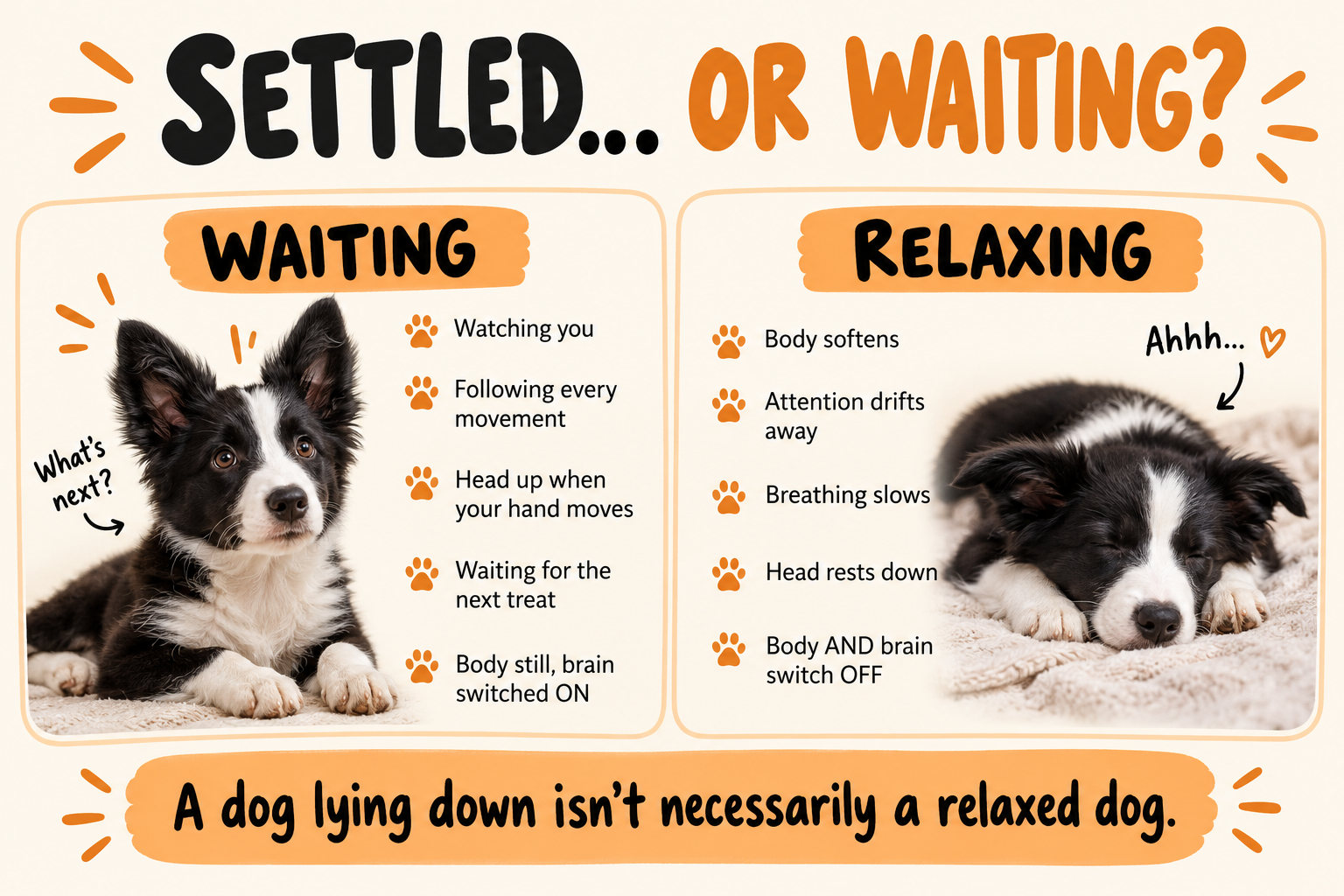
Being still and being relaxed aren't always the same thing. Look at the whole dog — not just whether they're lying down.
Brea's Tip 🧡
Ask yourself whether your dog is relaxed — or waiting.
Watch their body rather than just looking at their position.
Are they constantly watching you?
Do their eyes follow every movement?
Does their head shoot up if you move your hand?
Are they waiting for the next piece of food?
Or have they genuinely stopped caring what you're doing?
That distinction matters.
Does that mean I never use food around a mat?
No.
Food is a fantastic training tool.
I might use it to teach a dog to go to a particular place.
I might use it to build a positive association with somewhere new.
And there may be dogs who need more support before they're capable of relaxing in a particular environment.
But that's different from continuously feeding a dog for relaxing.
If I'm teaching the behaviour “go to your bed”, I'm training.
If I'm trying to develop an off-switch, at some point I need to stop being part of the activity.
The reward for switching off is getting to switch off.
Give relaxation its own cue
One thing I do with my own puppies is have a specific blanket that becomes associated with rest and sleep.
It goes in their crate when they're sleeping.
I use it during calm periods at home.
And because it repeatedly appears when nothing exciting is happening, the blanket gradually becomes part of that picture.
Blanket comes out → nothing is expected of me → it's time to switch off.
I'm not putting the puppy on the blanket and repeatedly asking them to lie down.
I'm not constantly feeding them for staying there.
I'm not trying to keep their attention on me.
Actually, I want the opposite.
I want that blanket to predict rest, not training.
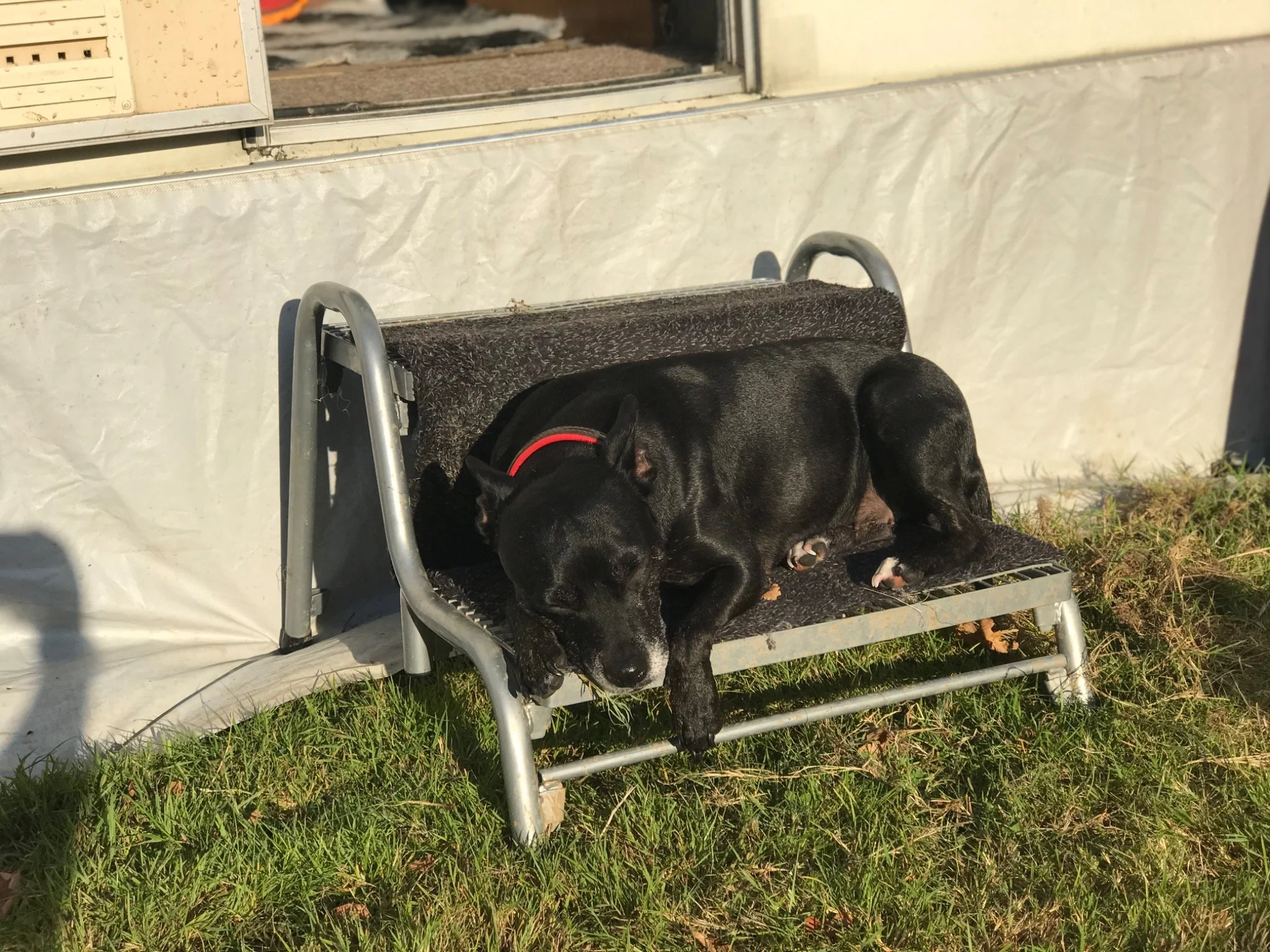
Over time, familiar resting places can become part of the picture — a little signal that nothing is expected of you right now. 🧡
And because it's portable, it can become incredibly useful later.
The same blanket can come to a café.
To training.
On holiday.
Beside an agility ring.
To somebody else's house.
Anywhere your dog might need a little help understanding that although the environment has changed, the expectation hasn't:
You don't need to do anything right now.
It's like taking a little piece of their relaxation routine with you.
Don't introduce the blanket when they're already at 100mph
This bit matters.
Don't wait until your puppy is ricocheting off the furniture, throw the blanket on the floor and expect them to think:
Ah yes. Time for some mindfulness.
Start when relaxation is already likely to happen.
Your puppy has been to the toilet.
Their needs have been met.
They're naturally becoming tired.
The house is fairly quiet.
Bring the blanket into those moments.
Let them sleep on it.
Let it become boring.
You're building an association over lots and lots of repetitions:
This blanket means I don't need to do anything.
Then, as that association becomes stronger, the blanket itself can start helping to provide context for settling.
Your environment matters too
We can't talk about teaching puppies to switch off without looking at what's happening around them.
If the television is blaring, children are running around, another dog is playing, people keep interacting with the puppy and toys are being thrown across the room...
they might struggle to settle.
That doesn't mean they'll always need perfect silence to sleep.
Quite the opposite — I want puppies to learn to relax around normal household life.
But there's a difference between normal life happening around them and everybody continually involving them in it.
Sometimes helping a puppy settle means making things a little easier.
Lower the excitement.
Put some toys away.
Use a puppy pen or crate if your puppy is comfortable there.
Give them somewhere they won't continually be disturbed.
And then...
leave them alone.
You don't need to keep checking whether they're relaxing.
Because repeatedly asking “ARE YOU RELAXED YET?” is, unsurprisingly, not particularly relaxing.
What about settling away from home?
This is where the skill becomes really useful.
I don't just want my dogs to be able to switch off when the house is quiet and nothing is happening. Eventually, I want them to be able to do it while life carries on around them.
At training.
At competitions.
In cafés.
On holiday.
While I'm working.
But that's something we build up to gradually.
I wouldn't go from:
I can sleep on my blanket in my quiet living room
straight to:
Please sleep underneath a table in a packed café on Saturday lunchtime.
That's a huge jump.
Just like any other skill, we gradually increase the difficulty. Start somewhere fairly quiet. Keep it short. Give your puppy the opportunity to watch what's happening without needing to interact with everything around them.
And don't panic if they don't immediately curl up and fall asleep.
Settling somewhere new is harder than settling at home.
Scorch is a good example of what I'm ultimately aiming for.
Here, he's settled on his bed while I'm teaching an agility class. There are dogs running, people moving around and plenty happening that he could be paying attention to — but none of it needs to involve him.
But we didn't start here.
This is the result of gradually building the skill in easier situations first and then taking it into more distracting environments.
The goal isn't to physically keep your dog on their bed or blanket while they desperately watch everything happening around them.
It's for the bed, the blanket and eventually the whole routine around settling to help them understand that they're allowed to disengage.
They don't need to watch every dog.
They don't need to investigate every noise.
They don't need to be involved just because something interesting is happening.
And for dogs who naturally want to be part of absolutely everything, that's a pretty valuable skill to have.
Reality check
Your puppy will not always settle.
Sometimes they're not tired.
Sometimes the environment is too exciting.
Sometimes they need the toilet.
Sometimes they're hungry.
Sometimes they're uncomfortable.
Sometimes you've asked too much of them.
And sometimes they're a puppy and apparently today the concept of lying down is offensive.
That's okay.
We're not trying to create a puppy who spends their entire life asleep on a blanket.
We're developing another skill they can use when they need it.
If they're genuinely struggling, look at why rather than repeatedly insisting that they settle.
Switching off shouldn't require exhaustion
Ultimately, I don't want to have to exhaust a dog before they're capable of resting.
I don't want them to need constant entertainment.
And I don't want relaxation to become another performance they have to offer me in exchange for food.
I want them to learn:
Sometimes exciting things happen.
Sometimes we train.
Sometimes we play.
Sometimes we explore the world.
And sometimes?
Absolutely nothing is happening.
And that's okay too.
Teaching your puppy to switch off isn't really about teaching them to lie on a blanket.
It's about helping them learn that they don't have to be involved in everything.
They don't always need to be doing something.
They don't always need to be watching you.
They don't always need to be waiting for what's next.
Sometimes they can just...
sleep.
And once you've lived with a puppy who can genuinely do that?
You'll appreciate what an underrated life skill it really is.
Got a puppy who genuinely doesn't have an off switch?
Learning to relax can take practice too.
If your puppy struggles to settle, constantly needs entertaining or finds it difficult to switch off when life is happening around them, Everyday Coaching can help you build those skills gradually — without needing to exhaust them first.