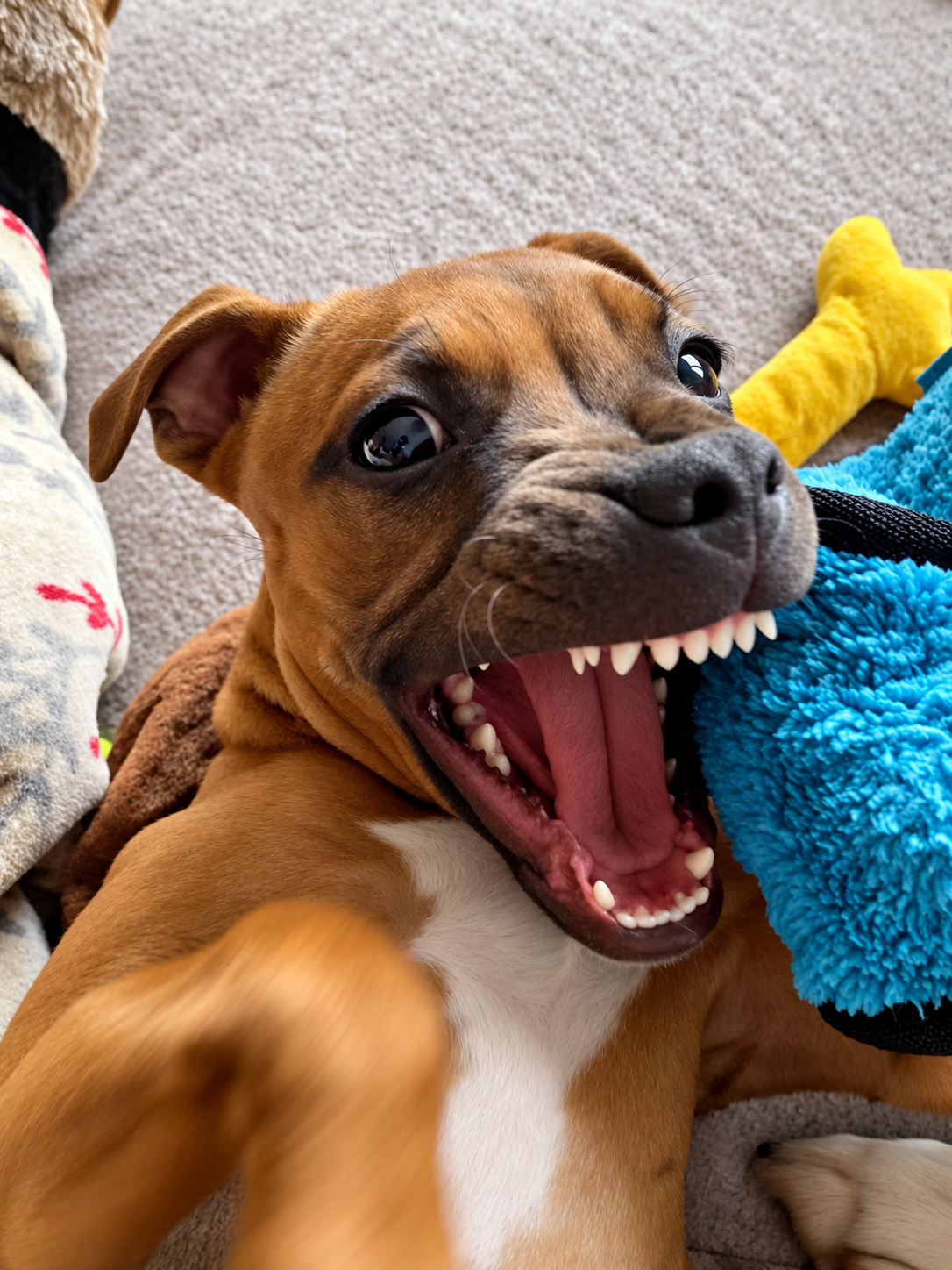
The face of innocence. Obviously. Puppy biting can feel relentless — but there's usually more going on than a puppy simply being ‘naughty’.
Why your puppy is biting you, why it can feel completely relentless — and what actually helps.
You imagined puppy cuddles.
Tiny paws. A little warm body asleep on your lap. Maybe some adorable photos of them peacefully chewing one of the seventeen carefully selected toys you bought before they came home.
Instead, you've apparently brought home a tiny land shark with absolutely no respect for human skin.
Your hands are scratched. Your clothes have holes in them. Walking across the room has become a high-risk activity because there's a puppy attached to your trouser leg.
And despite repeatedly offering them a perfectly good chew toy, they remain absolutely convinced that you are better.
Welcome to puppy biting.
The good news is that biting, mouthing and grabbing are incredibly normal puppy behaviours.
The slightly less exciting news?
Normal doesn't mean you just have to stand there and let them eat you.
Why does my puppy bite so much?
Because they're a puppy.
Which sounds like a spectacularly unhelpful answer, but it's actually important.
Puppies explore with their mouths. They play with their mouths. They investigate things with their mouths. They haven't yet learned how humans expect them to behave, and they certainly haven't arrived knowing that teeth on human skin is frowned upon.
Add in teething, excitement, frustration and a developing ability to regulate themselves and you've got a pretty convincing little shark.
But there's something else I want you to pay attention to:
When does the biting happen?
Because the biting itself doesn't always tell us what the puppy needs.
Teething is a pretty big deal
It's worth remembering what's actually happening inside your puppy's mouth during those first few months.
Puppies start with 28 baby teeth, which then have to fall out and be replaced as their adult teeth come through. By the time they're finished, most adult dogs have 42 teeth.
That's a LOT happening in a very small mouth in a relatively short space of time.
Their gums can be sore and uncomfortable, and chewing can help relieve some of that discomfort.
And I think this is where puppies sometimes deserve a little more empathy.
When a human baby is teething, we're incredibly understanding about it.
We expect them to be unsettled. We give them things to chew. We comfort them. We recognise that they're uncomfortable and, when appropriate, parents may even use pain relief following medical advice.
But when a puppy experiencing their own version of teething starts chewing the furniture, grabbing our hands or desperately looking for something to sink their teeth into, our first reaction can very quickly become:
NO.
Leave it.
Stop biting.
Or worse, they're punished for it.
Of course that doesn't mean letting your puppy chew through your kitchen table — or your arm.
But it does change how we approach the problem.
Instead of seeing a puppy who's being naughty, we can see a puppy whose mouth may genuinely be uncomfortable and ask:
What can I give them that meets that need safely?
Because stopping the behaviour doesn't make the need disappear.
The biting might be the symptom, not the problem
One of the most useful things you can do is stop thinking:
How do I stop my puppy biting?
and start asking:
Why is my puppy biting right now?
Because the answer might be very different at 9am compared with 8pm.
Your puppy might be:
overtired
overexcited
frustrated
hungry
needing the toilet
trying to initiate play
struggling with handling
teething
overwhelmed by what's happening around them
simply doing something that has become REALLY fun
And each of those puppies needs something slightly different.
A puppy who desperately needs sleep doesn't necessarily need another training exercise.
Sometimes they need you to help life become boring enough to fall asleep.
Brea's Tip 🧡
Keep a mental note of when the shark appears.
If the biting becomes absolutely feral at roughly the same time every evening, that's useful information.
If it always happens after a walk, during handling, when visitors arrive or after twenty minutes of play, that's useful too.
Patterns help us work out what your puppy might actually need.
Overtired puppies are absolute chaos
This deserves its own section because it's SO common.
Puppies need an enormous amount of sleep — and they aren't always particularly good at recognising when they need it.
An overtired puppy doesn't necessarily look sleepy.
They can look completely unhinged.
Zoomies. Barking. Grabbing clothes. Launching themselves at you. Biting harder. Unable to concentrate. Apparently possessed.
And understandably, people often think:
They've got loads of energy — I need to tire them out.
So they add another walk. More play. More stimulation.
And now you've got an even more exhausted puppy running entirely on chaos.
If your puppy has been awake for a while and suddenly turns into a velociraptor, consider whether they actually need less, not more.
Sometimes the answer to puppy chaos isn't another activity.
It's a nap.
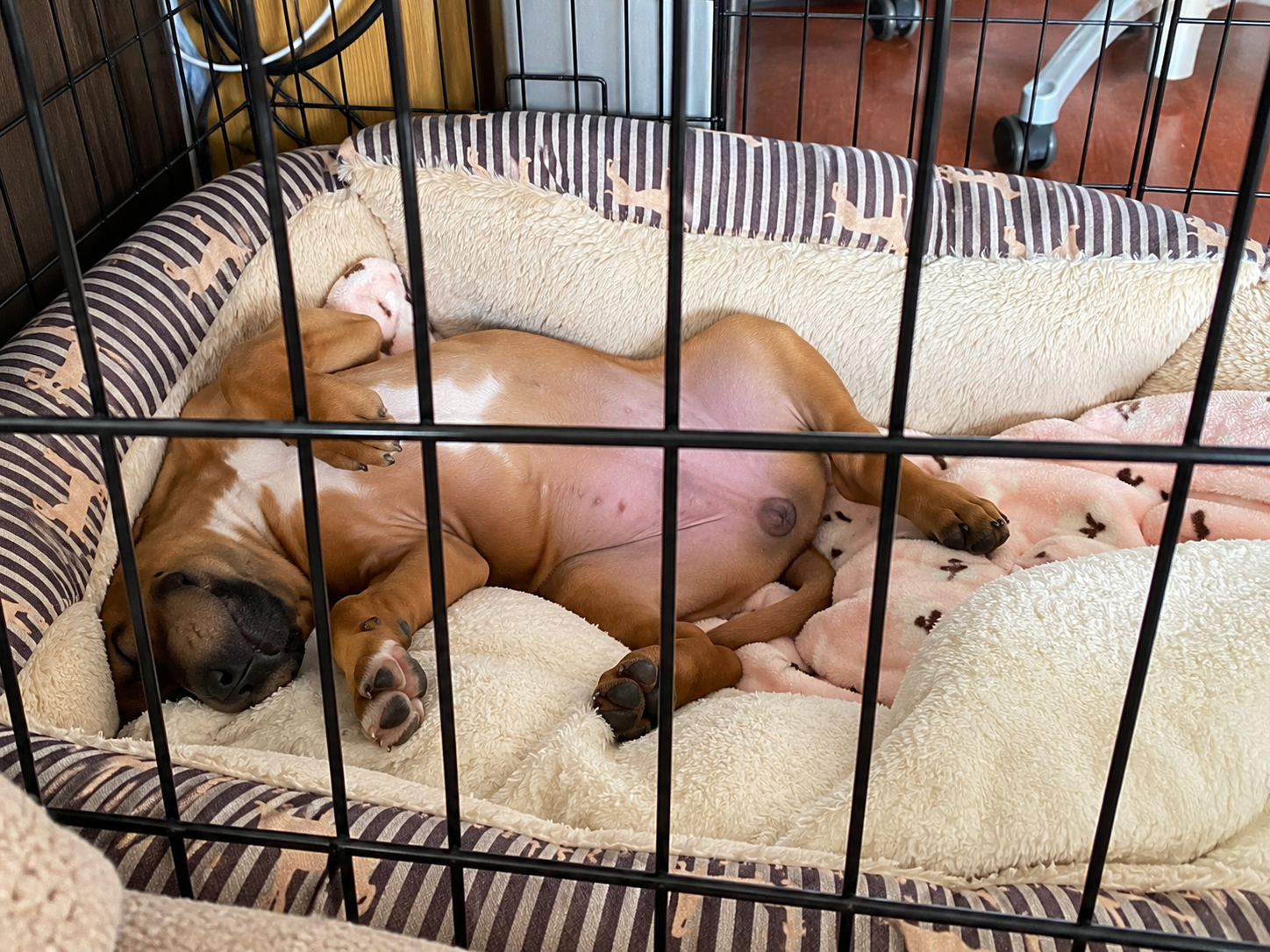
Exhibit A: the land shark has finally run out of battery.
“I've tried redirecting them to a toy…”
Of course you have.
The internet told you to.
And redirecting onto something appropriate can be useful.
Puppy grabs your sleeve → you offer a tug toy → puppy engages with that instead.
Lovely.
But if you've offered the toy fourteen times and your puppy continues launching themselves directly at your forearm, we probably need to stop pretending the fifteenth attempt is going to reveal the magic.
Redirection works best when your puppy is capable of being redirected.
If they're completely over-aroused, exhausted or frustrated, they may not need a better toy.
They may need a change in the situation.
That might mean ending play, creating some space, giving them something appropriate to chew, taking them outside for the toilet or helping them settle.
What should I do when my puppy bites me?
First: try not to turn yourself into the world's most exciting squeaky toy.
Pulling your hands away quickly, waving them around, squealing, pushing the puppy away or repeatedly grabbing at them can turn biting into a fantastic game.
For some puppies, yelping might interrupt them.
For others?
Congratulations. You have just squeaked. They would like to bite the toy again.
Instead, think about what you want your puppy to do next.
You might calmly offer an appropriate toy or chew.
If they're grabbing at you during play, you can pause the interaction.
If they're repeatedly biting clothing or skin and can't disengage, use your environment to calmly create some separation.
That might mean stepping behind a baby gate for a moment rather than trying to physically wrestle an increasingly excited puppy off your trousers.
Then ask yourself what they need before you start again.
Are they tired?
Do they need the toilet?
Are they hungry?
Do their gums need something satisfying to chew?
Has play simply gone on for too long?
The goal isn't just to stop the teeth.
It's to work out what needs to happen next.
Management will save your sanity
This is another reason I bang on about puppy pens and baby gates.
They aren't just for toilet training.
They give you ways to manage your puppy without constantly having to physically move them.
If your puppy is hanging from your dressing gown while you're trying to make breakfast, that's probably not the ideal moment for a thoughtful training session about impulse control.
Put some management in place.
Give them something appropriate to do.
Make breakfast with all your limbs intact.
You don't have to turn every difficult moment into a training exercise.
Sometimes good puppy raising is simply arranging the environment so everybody can cope.
Give them legal things to bite
Puppies need to chew — and during teething, they may have a very real physical reason for wanting to do it.
So rather than spending your entire day telling them what they can't put in their mouth, make sure they have plenty of things they can.
And this is where paying attention to what they've chosen to chew can be really useful.
Different puppies enjoy different textures, and matching the alternative to the thing they've chosen can make redirection much more successful.
Brea's Tip 🧡
Match the texture they're looking for.
If your puppy keeps going back to something, think about what they might actually be enjoying about it.
Chewing the corner of a cushion?
Try offering something soft or fabric-based that's appropriate for them to chew.
Obsessed with the wooden table leg?
They may be looking for something harder to get their teeth into. A suitable hard chew or something like a carrot may be far more satisfying than handing them another soft toy.
Grabbing and tugging at your clothes?
A longer soft tug toy might give them that same opportunity to grab and tug — without your jumper being involved.
Rather than thinking:
“What toy can I distract them with?”
try thinking:
“What are they getting from this, and how can I give them a better version?”
That's the difference between simply stopping a behaviour and giving your puppy an appropriate outlet for it.
Have a variety of safe, puppy-appropriate things available and rotate them rather than leaving everything out all the time.
And remember that chewing can be particularly useful when your puppy needs help winding down.
The goal isn't:
My puppy must never use their mouth.
It's:
Let's give that mouth somewhere more appropriate to go.
What about biting during handling?
This is one I wouldn't automatically dismiss as “just puppy biting”.
If your puppy consistently mouths, bites or struggles when you:
brush them
touch their paws
put on a harness
wipe them
look in their ears
restrain them
groom them
pay attention.
They may be playful.
But they may also be telling you that they're uncomfortable, worried, frustrated or finding the handling too difficult.
Rather than holding them still and pushing through it, make the task easier.
Work in tiny pieces.
Build positive associations.
Give them breaks.
And where appropriate, teach them that their cooperation matters.
Handling skills are something we can teach — not something puppies simply have to tolerate.
And if a puppy suddenly becomes much more sensitive to touch, seems painful or their behaviour changes significantly, that's something I'd want checked by a vet rather than assuming it's behavioural.
Reality check
There will probably be a point when you wonder whether your puppy is unusually aggressive.
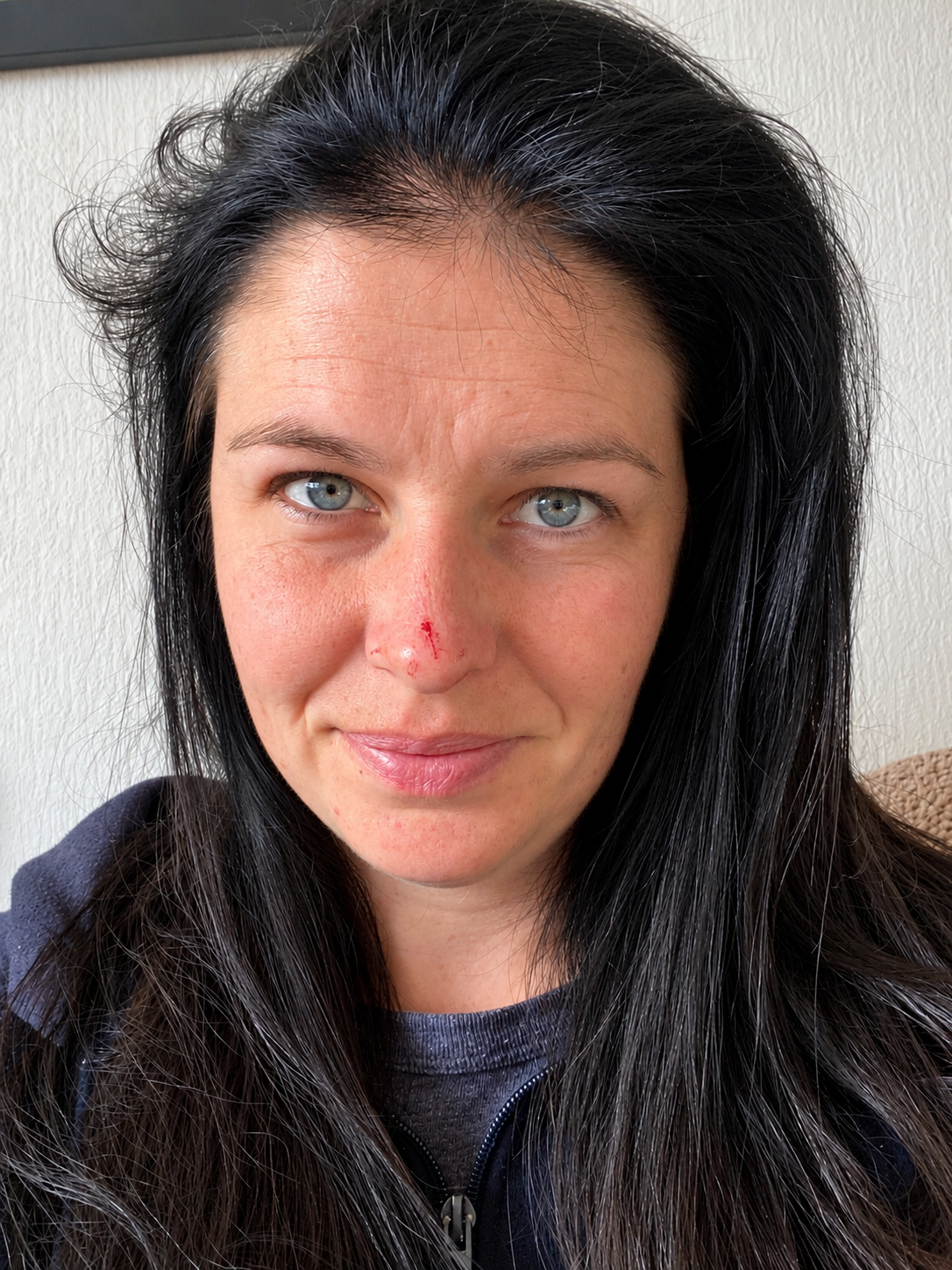
For anyone currently wondering whether everybody else's puppy bites this much... you're not alone. 😂
Usually around the moment they're hanging from your sleeve while making noises you weren't aware could come from something weighing 6kg.
Puppy biting can look dramatic.
Growling during play, grabbing, tugging, pouncing and using their mouth can all be part of normal puppy behaviour.
But “puppies bite” also shouldn't be used to dismiss everything.
If you're seeing biting alongside significant fear, guarding, pain, unusual sensitivity to touch, behaviour that concerns you, or you're simply struggling to cope with it, get appropriate help.
You don't need to wait until it becomes a much bigger problem before asking.
It won't disappear overnight
There isn't one trick that makes puppy biting stop tomorrow.
Sorry. I'd be considerably richer if there were.
What helps is looking at the whole picture:
Enough sleep.
Appropriate outlets for chewing and play.
Management.
Teaching alternative behaviours.
Not accidentally turning biting into the best game in the house.
Recognising when your puppy is becoming overwhelmed.
Understanding that teething can be uncomfortable.
And gradually helping them learn how to regulate themselves as they grow.
Your puppy isn't giving you a hard time.
They're having a very puppy-shaped time — and they still need your help learning what to do with themselves.
So protect your ankles, hide your favourite jumper and keep something appropriate within grabbing distance.
And one day, probably without you noticing exactly when it happened, you'll realise that you haven't had to detach a puppy from your trousers for quite a while.
Your clothes may never recover.
But you will.
Still living with a tiny land shark? 🦈😂
Sometimes puppy biting is completely normal puppy behaviour.
Sometimes there's more going on.
If you're struggling to work out why your puppy is biting — or you're reaching the point where none of your clothes have survived intact — we can look at what's driving it and build practical strategies around your puppy and your home.