

Meeting more doesn't automatically mean socialising better.

Shrimp as a puppy, learning that being around the world doesn't mean she has to interact with all of it.
You bring your puppy home and suddenly everybody has advice.
Take them everywhere.
Make sure they meet loads of dogs.
Get lots of people to handle them.
They need to experience everything while they're young.
And somewhere along the way, puppy socialisation became a giant game of bingo.
Dog ✅
Child ✅
Man with beard ✅
Bus ✅
Umbrella ✅
Person wearing a hat ✅
Shopping trolley ✅
The problem?
Exposure isn't automatically a positive experience.
And ticking something off a list tells us absolutely nothing about how your puppy actually felt about it.
What is socialisation actually for?
The goal isn't to create a puppy who wants to interact with absolutely everything they see.
In fact, for most dogs, that's not particularly useful.
I don't need my puppy to think:
DOG! MUST SAY HELLO!
every time another dog appears.
I'd much rather they learn:
There's a dog. That's fine. I can carry on with my life.
Good socialisation is about helping your puppy develop the confidence and skills to exist comfortably in the world they'll actually live in.
Sometimes that means interacting.
But very often it means watching, noticing and moving on.
Exposure and interaction aren't the same thing
This is probably one of the biggest things I wish more puppy owners were told.
Your puppy can experience something without having to interact with it.
They can watch children playing from a comfortable distance.
They can sit outside a café without every person coming over to stroke them.
They can see another dog without going over to say hello.
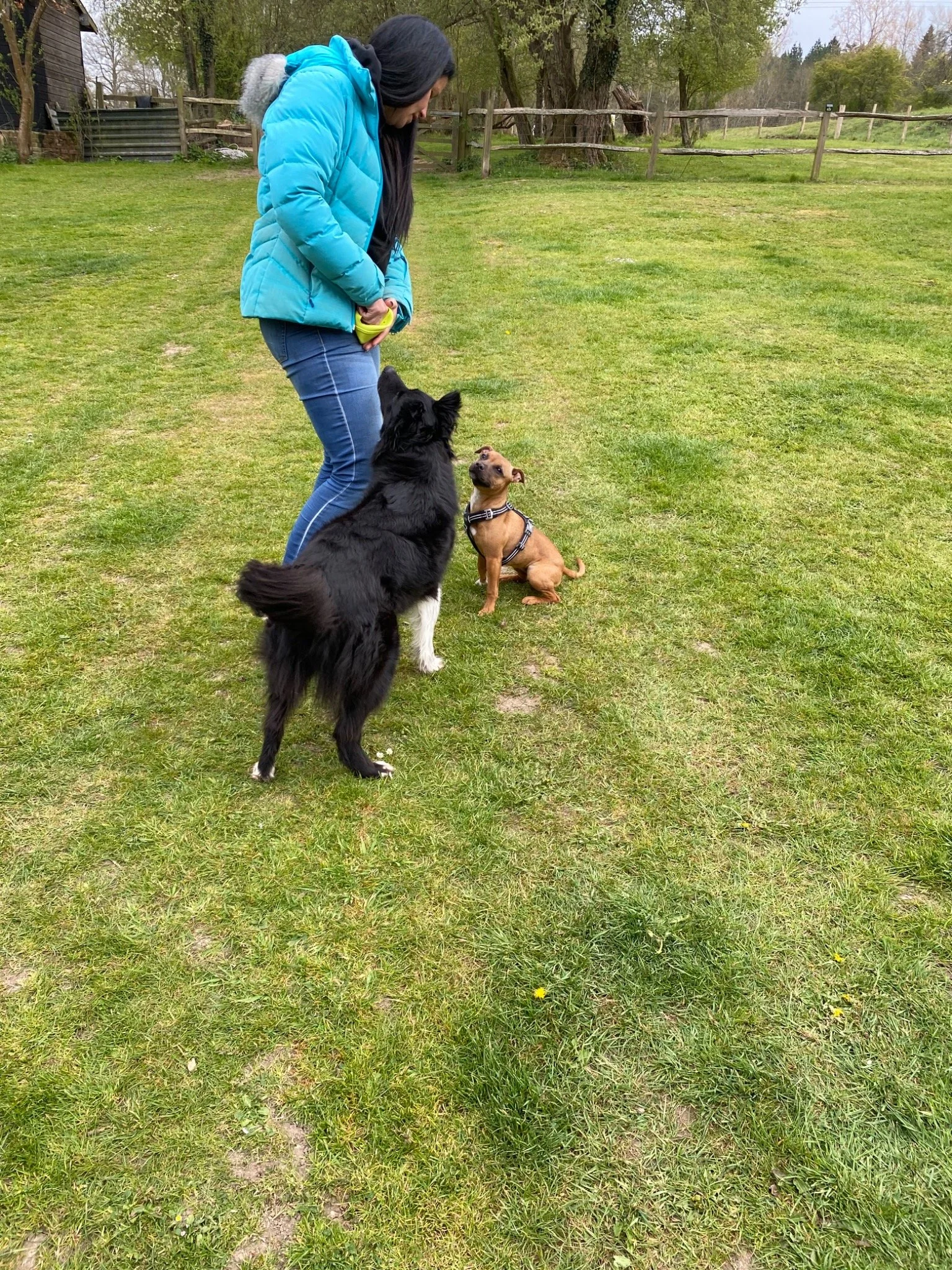
Being around another dog doesn't have to mean interacting with them. Learning to simply exist around other dogs is a valuable skill in itself.
They can hear traffic without walking straight alongside a busy road.
They can watch horses, bicycles, pushchairs or runners go past while eating a few treats with you.
That still counts.
Actually, for a lot of puppies, that's far more useful.
Because we're teaching them that things can exist around them without those things becoming their responsibility.
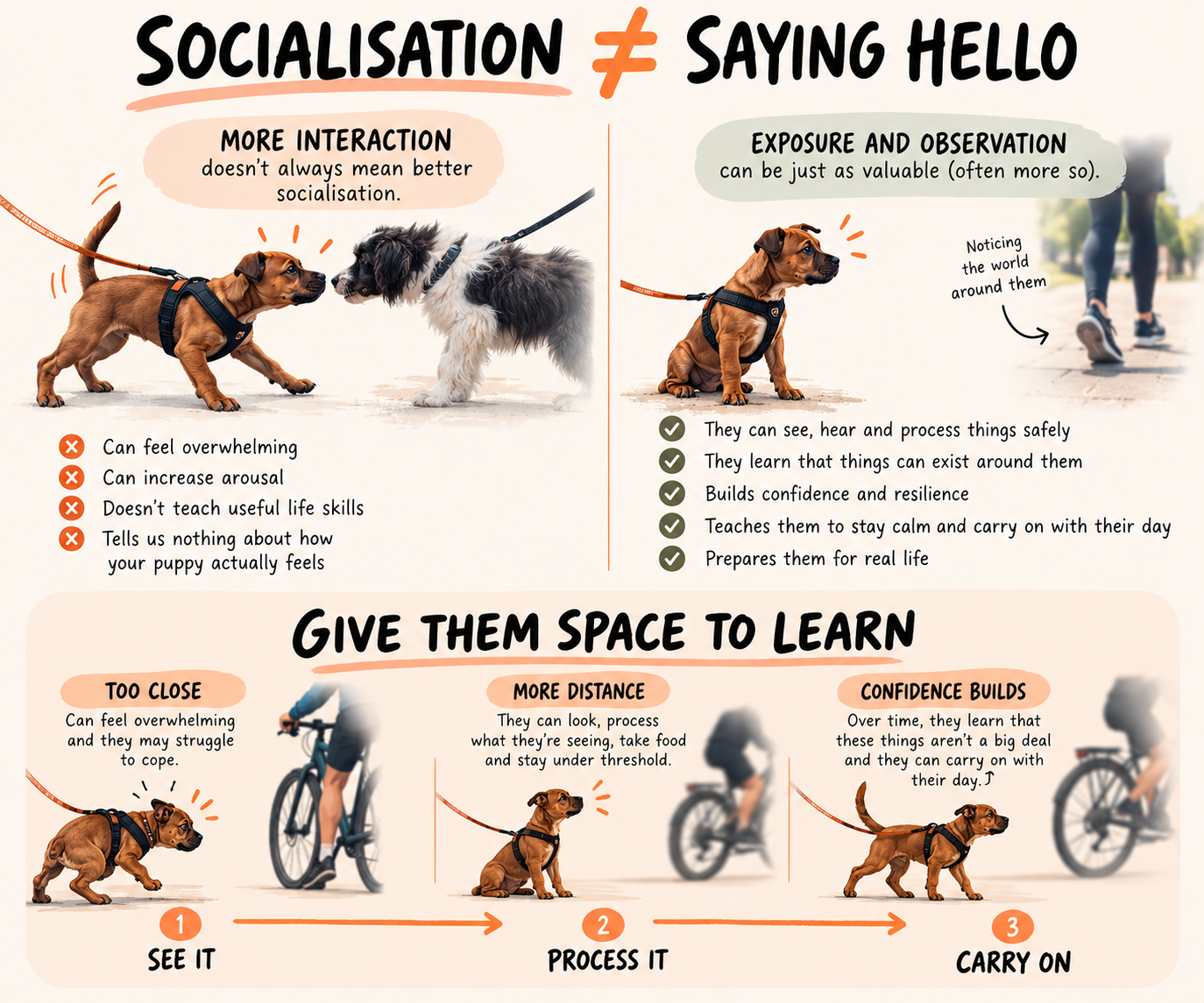
Good socialisation isn't about collecting interactions — sometimes the most valuable skill is simply noticing something and carrying on. 🧡
Your puppy gets a vote
This is where the checklist mentality can really let puppies down.
Imagine your puppy is worried about a man wearing a hat.
A checklist tells us:
Needs more exposure to men in hats.
So we find another man in a hat and encourage him to come over, crouch down, offer food and stroke the puppy.
But if the puppy was already worried, we've potentially just made the experience more intense, not more positive.
Instead, I want to ask:
What is my puppy telling me?
Are they moving towards something willingly?
Can they eat?
Can they disengage?
Is their body relaxed?
Are they trying to create distance?
Do they have the option to leave?
We don't build confidence by repeatedly proving to a puppy that their concerns don't matter.
We build it by giving them experiences they can actually cope with.
Brea's Tip 🧡
Distance is your friend.
If your puppy notices something and seems unsure, your first thought doesn't need to be:
How do I get them closer?
Try:
How can I make this easier?
Often, adding a little distance is enough.
At a comfortable distance your puppy may be able to look, process what they're seeing, take food, sniff, check back in with you and eventually move on.
That's learning.
Standing two feet away while somebody desperately waves a piece of chicken in front of their nose isn't necessarily socialisation.
What should I socialise my puppy to?
This is where I'm going to annoyingly say:
It depends.
Because your puppy doesn't need somebody else's socialisation checklist.
They need preparation for their life.
A puppy who will live in central London needs different experiences from one living on a quiet farm.
A future agility dog may need to become comfortable around busy environments, barking dogs, loudspeakers, equipment and waiting calmly ringside.
A dog who will regularly visit cafés needs to learn that lying under a table while life happens around them is incredibly boring.
A dog living with children needs appropriate, carefully managed experiences around children.
Think less about:
What should every puppy experience?
and more about:
What will my puppy's normal life actually involve?
Then introduce those things gradually.
Don't forget the boring stuff
Some of the most valuable socialisation isn't exciting at all.
Learning to settle while people walk past.
Watching dogs without greeting them.
Hearing the doorbell.
Walking over different surfaces.
Being comfortable in the car.
Having paws, ears and body gently handled.
Experiencing household noises.
Watching the world from a bench.
Going somewhere new and doing... absolutely nothing.
Neutrality is an incredibly useful life skill.
Your puppy doesn't need to love everything.
They just need to learn that most things aren't a big deal.
What if my puppy is scared?
Don't panic and don't assume you've missed some magical socialisation window.
Move further away.
Reduce the intensity.
Give them time to observe.
Let them choose whether they want to investigate.
And if they're repeatedly frightened, struggling to recover or becoming increasingly worried about something, get appropriate professional support early rather than repeatedly exposing them in the hope they'll “get used to it”.
Because getting used to something and learning to tolerate being overwhelmed are not the same thing.
Reality check
You will not socialise your puppy perfectly.
Something will appear at six months old that apparently HAS NEVER EXISTED BEFORE IN THE HISTORY OF THE WORLD.
It may be a wheelie bin.
A traffic cone.
A person carrying an umbrella.
A suspiciously shaped hedge.
Welcome to puppies.
The aim isn't to show them every possible thing while they're tiny.
It's to help them develop enough confidence, resilience and trust that when something new does appear, they're better equipped to deal with it.
Socialisation isn't a race
There isn't a prize for the puppy who's visited the most places by 16 weeks.
Slow it down.
Watch the puppy in front of you.
Give them choices.
Let them observe.
Protect their sleep.
Choose quality over quantity.
And remember:
You aren't trying to raise a puppy who needs to interact with the whole world.
You're helping them learn that they can feel safe living in it.
Want help building your puppy's confidence?
Good socialisation isn't about racing through a checklist. It's about helping your puppy learn how to cope confidently with the world they'll actually live in.
If you're unsure how much to expose them to, when to step in or how to support a puppy who's finding things difficult, Everyday Coaching gives us the space to work through it together.