

A little preparation now can make those first few weeks much easier.
Bringing home a puppy is ridiculously exciting.
It's also very easy to spend the weeks beforehand buying tiny collars, choosing beds and wondering whether you need seventeen different types of chew... while forgetting to prepare for the small furry chaos machine that's about to move into your house. 😂
Because the most useful preparation isn't really about what you buy.
It's about making it easier for your puppy to get things right.
Your puppy is about to leave everything they've known — their mum, littermates, familiar people, smells and surroundings — and arrive in a completely new environment with absolutely no idea what your household rules are.
They don't know that the rug isn't a toilet.
They don't know that electrical cables aren't chew toys.
They don't know that you eventually need them to stay happily at home while you go to work.
And they definitely don't know that the expensive new dog bed is for sleeping on rather than systematically dismantling.
None of that makes them naughty.
They're just new here.
So before your puppy comes home, rather than thinking only about what you need to teach them, it's worth asking:
How can I set things up so they don't get everything wrong?
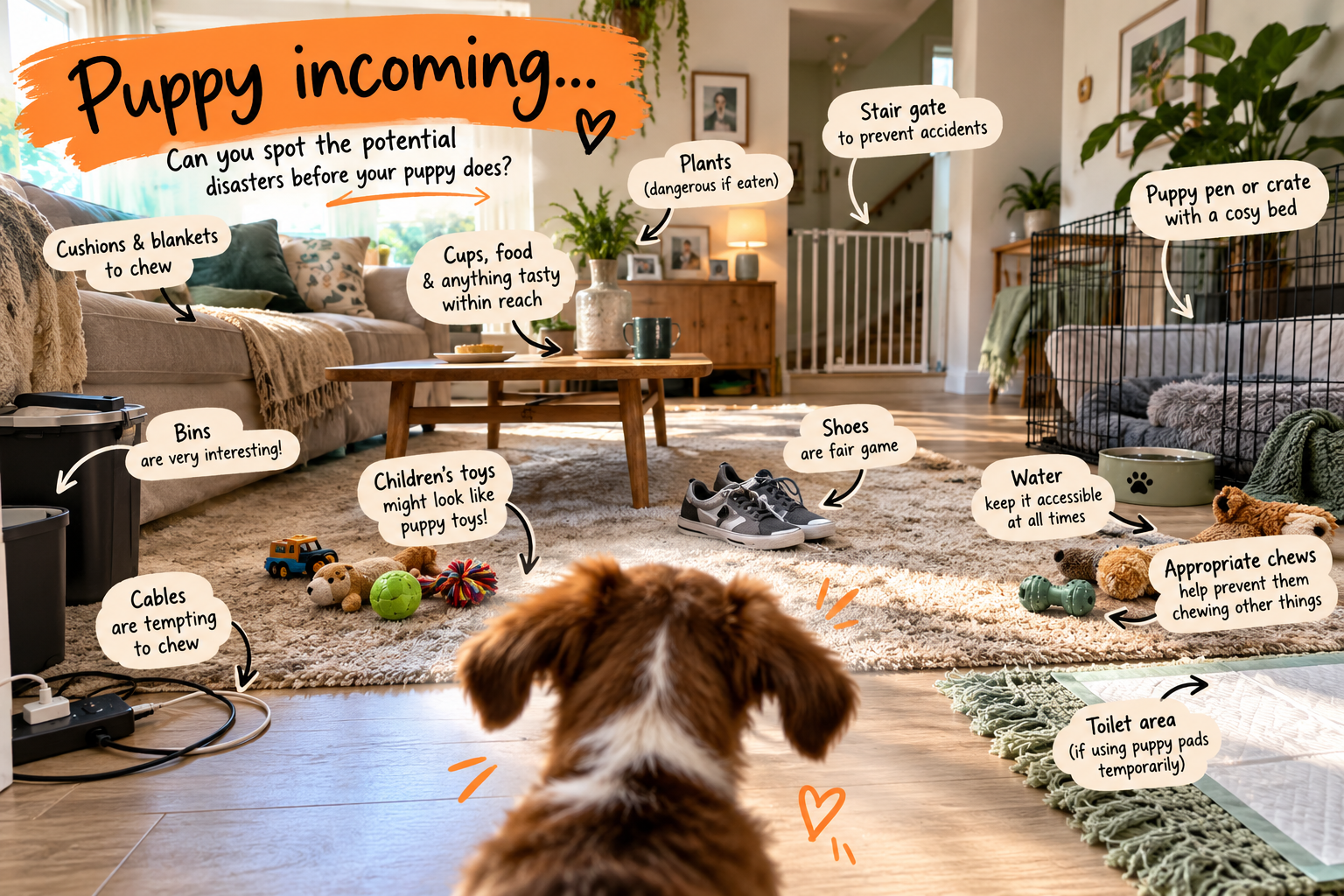
Puppy-proofing infographic showing a living room from a puppy's perspective, highlighting potential hazards including electrical cables, shoes, children's toys, bins, food and houseplants, alongside useful preparations such as a stair gate, puppy pen or crate, fresh water and appropriate chews.
FREE PUPPY CHECKLIST 🧡
Before you start: I've made you a printable Before Your Puppy Comes Home Checklist to go with this guide. You'll find it at the bottom of the page. 🧡
Start with management, not training.
When your puppy first comes home, they don't need to learn every rule of your house immediately.
In fact, one of the easiest ways to make puppyhood unnecessarily stressful is to give a puppy access to absolutely everything... and then spend your entire day following them around saying:
“No.”
“Leave that.”
“Get down.”
“What's in your mouth?”
“WHERE DID YOU EVEN FIND THAT?!”
Management simply means setting up your puppy's environment so that making good choices is easier — and practising unwanted behaviours is harder.
Baby gates can keep tempting rooms temporarily out of bounds. A puppy pen can give you somewhere safe to put your puppy when you can't supervise them properly. Shoes can live somewhere inaccessible. Children's toys can come off the floor. Bins can have lids. Cables can be moved or covered.
None of that means your puppy will need those things forever.
Management isn't a substitute for training. It gives you the breathing room to actually train.
Because every time your puppy steals a shoe and gets a brilliant game of chase around the kitchen, chewing shoes becomes a little more worthwhile.
Every time they discover something delicious in the bin, checking the bin becomes a pretty sensible thing to try again.
And every time we can prevent those rehearsals and give them an appropriate alternative instead, we're making the behaviour we do want easier to build.
Think in zones
Your puppy doesn't need immediate access to your entire house.
I'd actually encourage you to decide before they arrive where they'll spend most of their time during those first few weeks.
Ideally, you want an area that's easy to supervise, easy to clean and close to normal family life.
From there, you can gradually give them more freedom as they learn how life in your house works.
Freedom is something you can add. It's much harder to un-teach a habit they've already spent three weeks practising.
Decide where your puppy is going to sleep.
Before your puppy arrives, have a think about where you'd eventually like them to sleep.
That might be in a crate, a puppy pen, a dog bed in your bedroom, downstairs, upstairs — or, despite everything you said before getting a puppy, taking up 80% of your bed within approximately three weeks.
There isn't one sleeping arrangement that's right for every household.
But it's worth remembering what those first few nights look like from your puppy's perspective.
They've probably spent their entire life so far sleeping alongside their mum and littermates. Then, in one day, everything changes.
New house. New smells. New people.
And suddenly they're expected to sleep alone too.
You don't have to choose between comforting them and creating independence.
Supporting a puppy when they're unsettled doesn't mean you're teaching them that they can never sleep alone.
For some puppies, having their crate or bed beside you initially can make those first nights considerably easier. Once they're settling confidently, you can gradually move their sleeping area towards wherever you'd eventually like it to be.
Other puppies adjust remarkably quickly and need very little help.
Work with the puppy in front of you.
If they're crying, think about why before deciding what to do.
Do they need the toilet? Are they frightened? Are they uncomfortable? Have they just woken up somewhere unfamiliar and realised they're completely alone?
Crying is communication — not a puppy plotting how to manipulate you at nine weeks old.
Expect broken sleep at first.
Very young puppies may need toilet trips during the night.
Keep them boring.
Outside, opportunity to toilet, quiet praise if they do, then back to bed. 2am is not the time to discover that your garden is an excellent place to play tug.
As their bladder capacity develops and they become more settled in their new home, those overnight trips should gradually reduce.
And if the first few nights aren't perfect?
That's okay.
Your goal isn't to prove that your puppy can cope alone from night one.
It's to help them feel safe enough that independence can develop.
Toilet training is mostly a management problem.
Your puppy doesn't arrive knowing that outside is the toilet.
They also don't understand that the kitchen floor is unacceptable but the patch of grass three metres away is perfect.
We have to teach them.
And the easiest way to do that is to give them lots of opportunities to get it right.
Don't wait for your puppy to ask.
In the early days, take them outside far more often than you think you need to.
Particularly:
after waking up
after eating or drinking
after playing
after training
after excitement or visitors
before bed
and regularly in between
When they toilet outside, quietly reward them.
Food is useful here because you're making the message really clear:
That thing you just did? Do that here again.
Over time, your puppy starts developing a preference for toileting in the places that have consistently worked for them.
Brea’s tip 🧡
Keep a small notebook and pen by the back door.
Every time your puppy toilets, quickly jot down the time and whether it was a wee or a poo.
It sounds ridiculously simple, but after a few days you'll often start to spot patterns — how soon they need to go after eating, how frequently they're weeing when awake, or what time that suspiciously predictable evening poo tends to happen.
It also means everyone in the household knows when the puppy last went, rather than having the inevitable:
“When did they last wee?”
“Erm... I think you took them out?”
The more you understand your puppy's pattern, the easier it becomes to get them outside before the accident happens.
Toilet training gets much easier when you're predicting rather than reacting.
Accidents are information.
If your puppy wees on the floor, they haven't failed toilet training.
And they certainly don't need telling off.
Ask yourself what happened.
Did we leave it too long? Did they wake up without us noticing? Were they playing and suddenly need to go? Did we miss the sniffing and circling because we were making dinner?
Clean it thoroughly — ideally with an appropriate enzymatic cleaner — and adjust what you do next time.
The accident has already happened. Punishing your puppy afterwards can't teach them where you wanted them to go.
At worst, it can teach them that toileting in front of you isn't safe — which can make toilet training considerably harder.
Supervise, contain or take them outside.
This is probably the simplest toilet-training rule I can give you.
If your puppy is awake and wandering around the house, someone needs to have a reasonable idea of what they're doing.
If you can't supervise them, use the safe area you set up earlier.
And if you're thinking:
“They probably don't need to go yet...”
Take them out anyway.
You'll gradually learn your individual puppy's routine and won't need to be quite so obsessive forever.
What about puppy pads?
Puppy pads can be useful in some circumstances, particularly where getting a puppy outside quickly isn't realistic.
But if your eventual goal is for your puppy to toilet outside and you can take them outside regularly, I'd generally rather teach the final behaviour from the beginning than create an extra step to change later.
That doesn't make puppy pads inherently bad.
It just means it's worth thinking about what you ultimately want your puppy to learn.
Make the right place easy to access, give them plenty of opportunities to use it, and make it worthwhile when they do.
That's toilet training in a nutshell.
Start teaching alone time before you need it.
One of the loveliest things about bringing home a puppy is that, for the first few days, you probably want to spend every waking second with them.
And if you've taken time off work, it's very easy for your puppy to spend their first week with you never actually being alone.
Then real life starts again.
You need to go shopping. Go to work. Take the children somewhere. Have a shower without a tiny dog sitting on your feet.
And suddenly we're asking a puppy who has had constant company since the day they were born to cope with being completely alone.
Independence starts with tiny moments.
You don't need to leave your puppy for an hour to “teach them” to be alone.
In fact, I'd much rather start ridiculously small.
Your puppy is happily occupied with a chew while you walk into the kitchen.
You step behind a baby gate for a few seconds.
You pop upstairs and come straight back down.
You close the bathroom door rather than inviting your new audience in with you.
These tiny, uneventful separations help your puppy learn:
People disappear sometimes. And they come back.
As your puppy becomes comfortable, you can gradually build from seconds to minutes and eventually to longer periods.
Don't wait until they're upset.
This bit matters.
The aim isn't to leave your puppy until they cry and then wait for them to “give up.”
We're trying to build an experience they can actually cope with.
If your puppy becomes worried almost immediately, that's useful information. The step was too difficult.
Make the next repetition easier.
Maybe you're only on the other side of a gate. Maybe you move around the room while they relax in their bed. Maybe you step out of sight for one second rather than thirty.
There's no prize for progressing quickly.
Confidence comes from lots of successful repetitions — not from proving they can survive a difficult one.
Being physically apart while you're still home counts too.
This is something I'd really encourage from the beginning.
Your puppy doesn't need to follow you from room to room all day simply because you're both in the house.
Use those safe areas we talked about earlier. Let them settle with a chew while you make dinner. Encourage naps somewhere other than directly on top of you. Move around the house while they stay somewhere comfortable.
You're not ignoring them.
You're helping them learn that being apart from you is a completely normal part of everyday life.
And don't sneak out.
When you eventually start leaving the house, departures and arrivals don't need to become huge events.
You don't need an emotional five-minute goodbye — but equally, I don't love the idea that you must disappear while your puppy isn't looking.
Leaving can simply become boring and predictable.
Pick up your keys. Leave. Come back.
Nothing terrible happened.
Brea’s tip 🧡
Use a camera.
Even if you're only standing outside for a couple of minutes, being able to see what your puppy is actually doing is incredibly useful, it takes out the guesswork.
A puppy who finishes their chew, looks around and falls asleep is having a very different experience from a puppy who starts pacing, vocalising or becoming increasingly distressed the moment you leave.
Don't just measure alone time by the clock.
Measure it by how your puppy is coping.
Your puppy probably needs more sleep than you think.
Young puppies can sleep around 18–20 hours in a 24-hour period.
Yes, you read that right. EIGHTEEN TO TWENTY HOURS!
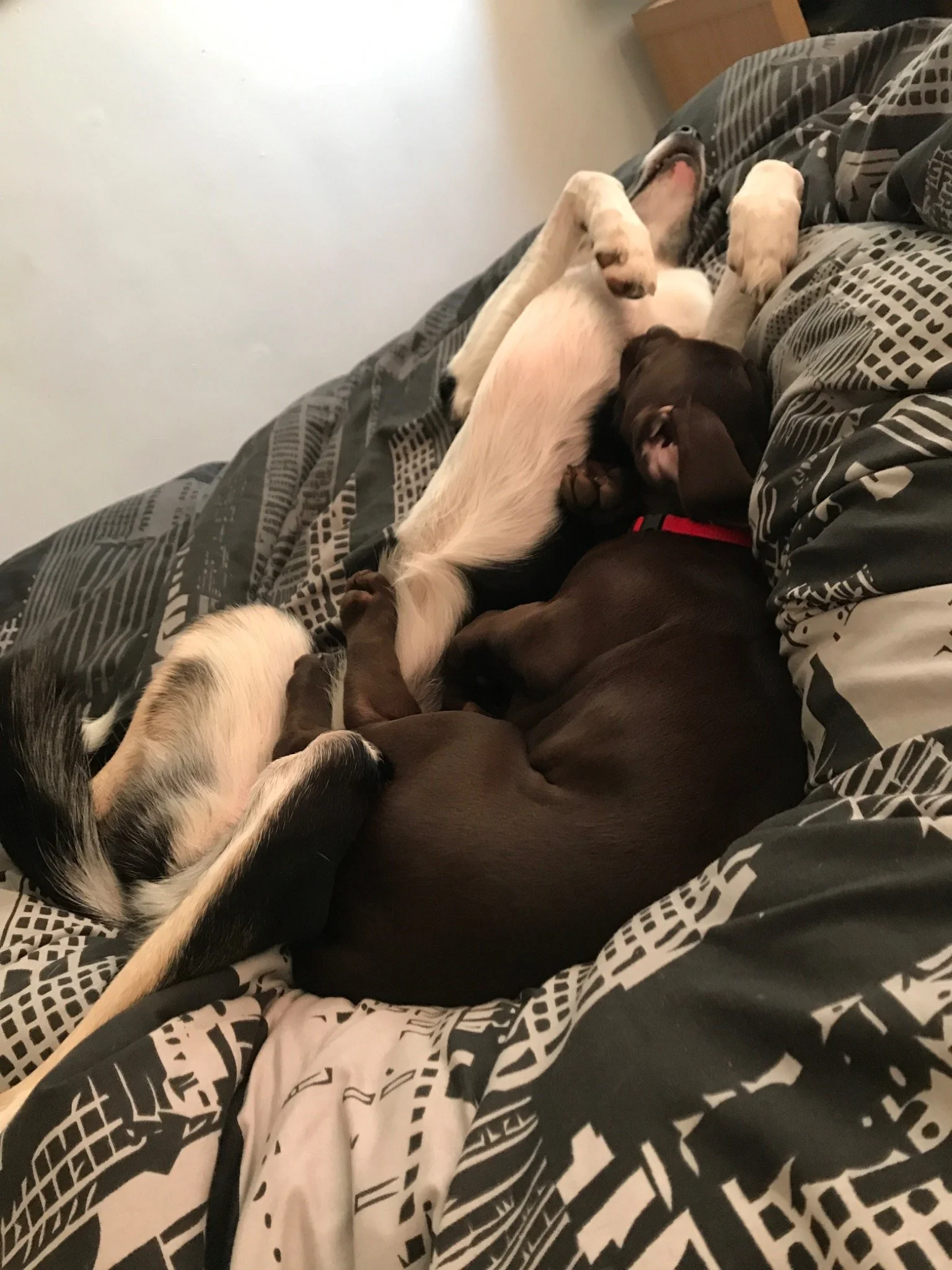
18–20 hours. Seriously.
Growing, learning and processing an entirely new world is exhausting work.
That means a young puppy might only be awake for around 4–6 hours across the entire day — and that awake time is usually broken into lots of relatively short periods rather than one big block.
Puppies are doing an enormous amount of growing and developing, while also processing a completely new world. Sleep supports their physical and neurological development, and it's completely normal for them to need frequent naps throughout the day.
Puppies are very good at making us think they need more.
More play. More walks. More training. More entertainment.
Sometimes what they actually need is a nap.
Young puppies need a lot of sleep, and they're not always particularly good at recognising when they're tired.
Instead, you might get the puppy who suddenly starts zooming around the living room, biting your ankles, grabbing your clothes, launching themselves at the sofa and apparently forgetting every single thing they've learned that day.
It's very easy to look at that puppy and think:
“They've got so much energy — I need to tire them out!”
When actually, you may be looking at an overtired puppy who desperately needs help switching off.
Build rest into the day.
Your puppy doesn't need to be entertained every moment they're awake.
Training, exploring, playing, meeting people and experiencing the world are all tiring — particularly when everything is brand new.
Give them opportunities throughout the day to sleep somewhere comfortable and relatively undisturbed.
That might be a crate, pen, bed or quiet area of the house. It doesn't particularly matter what it looks like as long as your puppy feels safe and is able to properly relax there.
And if you've got children, other dogs or a busy household, this becomes even more important.
Sleeping puppies need to be allowed to sleep.
Don't create an athlete by trying to exhaust them.
Exercise is important, but more physical exercise isn't always the answer to a puppy who struggles to settle.
If every time your puppy becomes lively you add another walk, another game or another half-hour of high-energy play, you can end up with a puppy who becomes very good at being busy without ever learning how to come back down again.
Learning to rest is a skill too.
We want puppies who can explore, play, train and enjoy being active...
and then switch off afterwards.
Brea’s tip 🧡
If your puppy suddenly transforms into a tiny piranha every evening, don't automatically assume they need more entertainment.
Think back over their day.
When did they last properly sleep?
Sometimes the answer to the 7pm witching hour isn't another activity.
It's bedtime.
SOMETIMES THE TRAINING PLAN IS JUST:
Let the baby sleep.
What do you actually need to buy?
Walk into any pet shop with a new puppy on the way and you could quite easily convince yourself you need approximately £700 worth of tiny dog belongings.
You don't.
Your puppy needs somewhere safe to sleep, something appropriate to eat and drink from, a way to travel safely, some suitable things to chew and play with, and the basic equipment you'll need to start navigating life together.
Everything else can come later.
Start with the essentials.
Before your puppy arrives, I'd make sure you've got:
The food they're already eating. Even if you plan to change it, those first few days probably aren't the time to simultaneously change their home, family and diet. You can transition gradually later.
Food and water bowls. They don't need to match your kitchen. Your puppy will not care.
A collar and ID tag. This isn't just a useful precaution — it's a legal requirement. Under the Control of Dogs Order 1992, dogs on a highway or in a public place must wear a collar showing the owner's name and address, either written on the collar itself or on a tag/plate attached to it (with limited exemptions for certain working dogs). Worth knowing: a phone number is sensible to add, but it doesn't replace the legally required name and address.
A well-fitting harness and lead. Your puppy will grow quickly, so don't spend a fortune assuming their first harness will last forever.
A bed and/or crate or puppy pen, depending on how you've decided to manage their space.
A selection of appropriate chews and toys. Different textures are useful — particularly once teething gets underway.
Poo bags. More than you think. Always more than you think.
An enzymatic cleaner. Because despite everything we just discussed in the toilet-training section... there will probably be wee on your floor at some point.
Something to travel safely in the car. Don't wait until collection day to work this one out. The Highway Code says dogs and other animals should be suitably restrained so they can't distract the driver or injure themselves or you if you stop suddenly. It specifically gives a seat-belt harness, pet carrier, dog cage or dog guard as examples. So the puppy loose on someone's lap for the journey home might look adorable, but it isn't how we want to start their travelling career.
Basic grooming equipment appropriate for their coat. Brush, comb, nail-care equipment etc. will depend hugely on the dog you've chosen.
You don't need to buy everything immediately.
This is particularly true when it comes to toys, chews, beds and enrichment products.
You don't know your puppy yet.
You might buy twelve beautiful puppy toys only to discover their favourite possession is an empty cardboard box.
You might spend £80 on an aesthetically pleasing bed...
...and discover they'd rather sleep with their head wedged underneath the radiator.
Start with enough to meet their needs and learn what your individual puppy actually likes before filling the house with stuff.
One thing I would prepare plenty of: rewards.
You're about to have hundreds of tiny opportunities every day to reinforce things you like.
Your puppy follows you into the garden? Reward.
They choose to come towards you? Reward.
They settle quietly while you're making a coffee? Reward.
They voluntarily drop the sock they've just stolen rather than beginning a hostage negotiation? Definitely reward.
Some of those rewards can simply come from your puppy's normal daily food allowance, alongside other suitable treats.
Having rewards easily accessible around the house means you're much more likely to catch those lovely little behaviours as they happen.
Brea’s tip 🧡
Put small pots of treats in useful places around the house.
By the back door. Near the puppy pen. In the living room. Wherever you're likely to need them.
Good training opportunities rarely wait patiently while you rummage through a cupboard looking for the treat bag.
Make rewarding the behaviour you like as easy for yourself as possible.
Worth knowing
Microchipping doesn't replace an ID tag.
Your puppy may already be microchipped when they come home, but the requirement to wear a collar with the owner's name and address in public still applies.
And make sure you update the microchip registration with your own details when your puppy comes home — we'll cover that properly in the boring-but-important admin section next.
Sort the boring stuff before your puppy arrives.
I know.
You'd much rather be choosing toys.
But there are a few decidedly unexciting jobs that are much easier to sort before you're sleep deprived and following a puppy around the garden at 3am asking them to please, for the love of God, just have a wee.
Register with a vet.
Don't wait until your puppy is unwell to start looking for one.
Find a local veterinary practice you're happy with, check they're accepting new clients and register your puppy.
It's also worth finding out where your nearest out-of-hours emergency vet is and saving their number in your phone.
Hopefully you'll never need it.
But if you do, you won't want to be Googling it while panicking.
Sort your insurance.
If you're planning to insure your puppy, look into policies before they come home.
Don't just compare the monthly price. Look at what the policy actually covers, the veterinary-fee limit, whether that's per year or per condition, excesses, exclusions and how ongoing conditions are treated.
Some breeders or rescues provide temporary insurance when a puppy leaves them, but don't assume yours does — and make sure you know exactly when any cover ends.
Once something appears in your puppy's veterinary history, a new insurer may consider it a pre-existing condition.
Check the microchip.
In England, dogs must be microchipped and registered on an approved database by the required age, and the keeper is responsible for ensuring the registered details are kept up to date.
Your puppy may already have been microchipped before coming home, but that doesn't mean the job is finished.
Make sure you know:
Which database is the chip registered with? Has ownership been transferred? Are your name, address and contact details correct?
And remember from earlier: a microchip doesn't replace the legally required identification on their collar when they're out in public.
Find your puppy class before you need it.
Good puppy classes can fill up in advance.
You don't need to wait until your puppy is home, fully settled and bouncing off the walls before you start looking.
Research trainers beforehand so you have time to find someone whose approach you're comfortable with.
I'd be looking for small, well-managed classes that use reward-based training, give puppies space when they need it and don't turn “socialisation” into a free-for-all where every puppy is expected to play with every other puppy.
Puppy class should help you build skills and confidence together — not simply exhaust your puppy for an hour.
And think about grooming early.
If you've chosen a breed or crossbreed whose coat will require regular professional grooming, find a groomer now.
Don't wait until they're six months old, covered in knots and desperately in need of their first full groom.
Those early visits can be about learning that handling, standing on a grooming table, clippers, dryers, brushes and having different parts of their body touched are all perfectly normal things.
The first groom doesn't need to begin when the coat desperately needs cutting.
Before collection day, I'd want to know:
Who your vet is. Who you'd call in an emergency. Whether your insurance is arranged. Where the microchip is registered. How your puppy will travel home safely. And, ideally, where you're going for training and grooming if you'll need it.
None of it is particularly exciting.
But future sleep-deprived you will be very grateful that organised pre-puppy you sorted it.
Before collection day, ask a few questions.
Hopefully you'll already have had plenty of conversations with your breeder or rescue before this point.
But as collection day gets closer, there are some really practical things worth finding out.
Not because you need to recreate your puppy's previous home perfectly — but because the fewer things we change all at once, the easier those first few days can be.
Find out what their normal currently looks like.
Ask what food they're eating, how much and roughly when.
Find out where they've been sleeping. Have they been sleeping with their littermates? In a crate or pen? In a particular room? Are they used to household noises overnight?
Ask what their toilet routine looks like too. Have they started going outside? Are they using puppy pads, newspaper, grass or another surface?
None of this means you have to continue exactly the same routine forever.
It just gives you a useful starting point.
Ask what they've already experienced.
This is particularly useful when thinking about socialisation.
What people have they met? Have they experienced children? Other dogs or animals? Car journeys? Different surfaces? Household noises? Grooming and handling? Being away from their littermates for short periods?
Again, you're not looking for a completed checklist.
You're trying to understand the puppy who's actually coming home with you.
If they've never travelled in a car, for example, that's useful to know before planning a three-hour adventure the following day.
And if they've already had lots of positive experiences with something, brilliant — you can continue building on them.
Know what paperwork you're coming home with.
Make sure you understand what you'll be given when you collect your puppy, including their microchip information, vaccination record, details of any worming or parasite treatments they've received and any relevant health information.
If you're buying a pedigree puppy, there may also be registration paperwork and breed-specific health-testing information relating to the parents.
Don't be afraid to ask what something means.
A folder full of certificates isn't particularly useful if you've got no idea what any of them are.
Ask for something that smells like home.
If possible, ask whether you can bring home a small blanket or piece of bedding that smells familiar.
Your puppy is leaving behind their mum, littermates and the environment they've known for their entire life.
Having something carrying those familiar smells can be comforting during the journey home and those first few nights.
It doesn't need to be a beautiful personalised puppy blanket.
In fact, this probably isn't the moment to wash it because it smells a bit doggy.
That's rather the point.
And ask questions specific to your puppy.
What's their personality been like within the litter?
What do they enjoy?
What worries them?
Are they particularly confident, cautious, busy, independent, cuddly, persistent?
Have they discovered anything they're absolutely obsessed with?
These little pieces of information can be far more useful than knowing that you've bought “the confident one” or “the quiet one.”
Because once they arrive...
your job isn't to train the puppy you imagined you were getting.
It's to start getting to know the one who actually came home. 🧡
The first few days: do less than you think.
Your puppy is finally home. 🧡
And naturally, you want to show them everything.
The garden! The neighbourhood! Your parents! Your friends! The children next door! Your friend's lovely Labrador! The pet shop! The coffee shop!
Everybody wants to meet the puppy.
Meanwhile, your puppy has just had one of the biggest days of their life.
They've left the place they were born, travelled somewhere unfamiliar and arrived in a house full of new people, smells, sounds and expectations.
They don't necessarily need another twelve experiences before bedtime.
Give them time to land.
Those first few days can be surprisingly simple.
Let your puppy explore their new home at their own pace. Show them where they can toilet. Let them eat, sleep, play and start getting to know you.
You can begin rewarding lovely little behaviours as they happen, but you don't need to launch into formal training sessions the moment they walk through the door.
You're already teaching them.
Every interaction is helping them learn what life with you feels like.
That you're safe.
That good things happen around you.
That their needs will be met.
That this strange new place is starting to become home.
You don't need to invite everybody round.
I know everyone wants puppy cuddles.
They can wait.
Some puppies will happily bounce into a room full of visitors and think they've won the lottery.
Others will find it completely overwhelming.
And even the confident puppy who's delighted to meet everyone can still become overtired after being passed around for three hours.
Keep those early interactions manageable and watch the puppy in front of you.
Are they choosing to interact? Can they move away if they want to? Are they still relaxed? Are they getting tired?
Socialisation isn't about exposing your puppy to the maximum number of things in the shortest possible time.
Quality matters far more than quantity.
You don't need to start ticking boxes.
There's a lot of pressure around the puppy socialisation period.
It can make owners feel as though there's a countdown running in the background and they need to expose their puppy to every possible person, dog, animal, vehicle, surface and situation immediately.
You don't.
We absolutely want puppies to experience the world while they're young — but we want those experiences to be appropriate for the individual puppy and, wherever possible, positive.
Seeing something from a comfortable distance counts.
Watching the world while being carried counts.
Sitting somewhere quietly and observing counts.
Your puppy doesn't have to physically interact with something for it to be a useful experience.
We'll talk much more about this in the Socialisation Isn't a Checklist resource.
Keep their world small enough to feel safe.
That doesn't mean shutting your puppy away at home for weeks.
It means balancing new experiences with familiarity, rest and recovery.
One little adventure followed by a decent sleep may be far more valuable than an entire day of new experiences.
And remember: your puppy doesn't know they're behind schedule.
They don't know what your friend's puppy can already do.
They don't know what somebody on Facebook says their 10-week-old puppy can do.
They don't care that you've bought a training planner and written RECALL in Tuesday's box.
They've just arrived.
Get to know them.
Let them get to know you.
And build from there.
Your first-week goal
Don't aim for a perfectly trained puppy.
Aim for a puppy who's beginning to feel safe, understood and comfortable in their new home.
There is plenty of time for everything else.
Training built around your dog starts with getting to know the dog in front of you.
YOUR PUPPY CHECKLIST 🧡
Take the checklist with you.
I've condensed everything we've covered into one simple printable checklist so you can work through it before your puppy comes home.
Pop your details below and I'll send it straight to your inbox.
Want more help with your puppy? You can also choose to receive occasional training tips, new resources and updates from me — just tick Sign up for news and updates below. 🧡