You don't need to teach everything. Start with the things that make everything else easier.
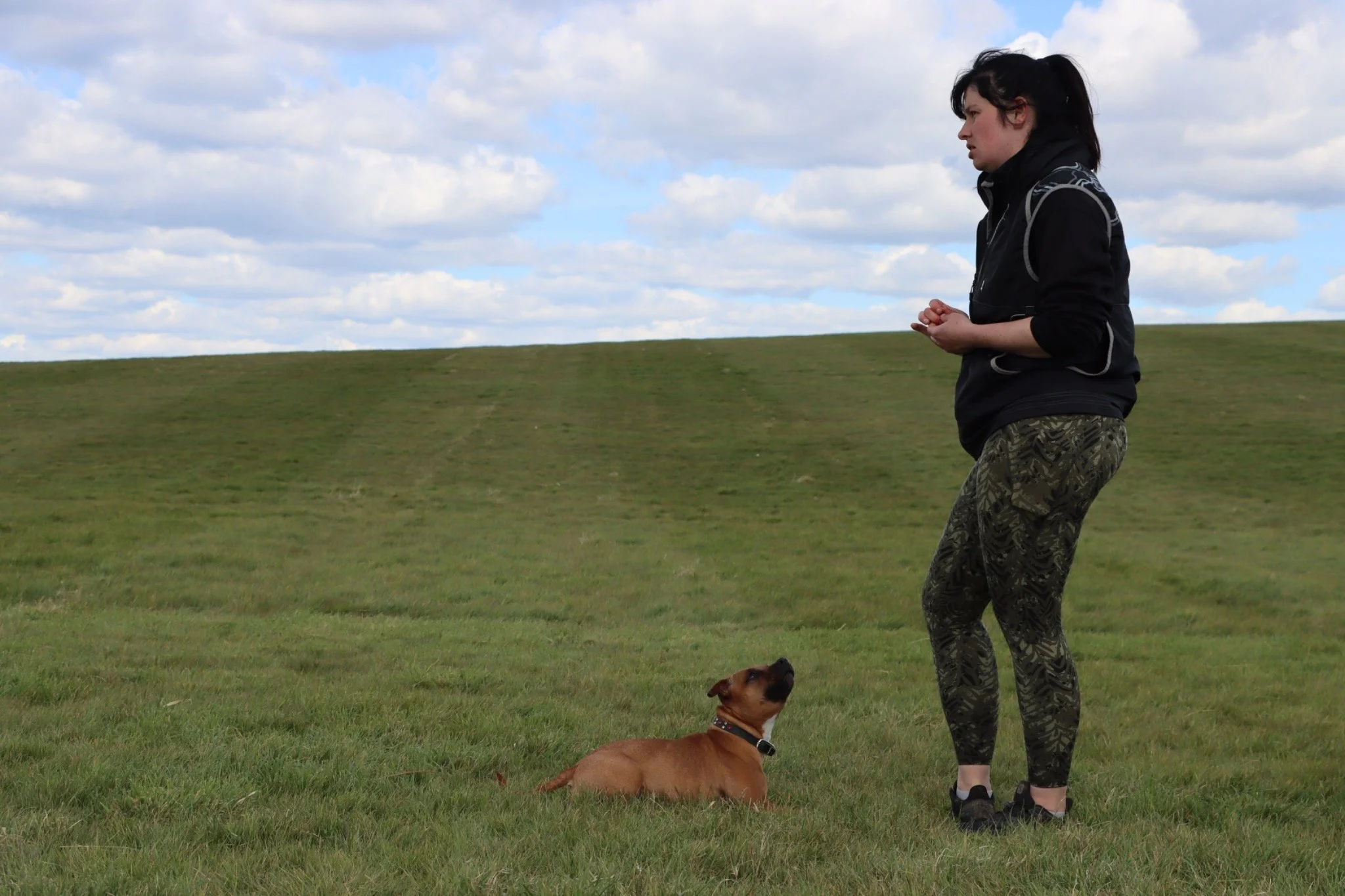
Good training foundations aren't about how many behaviours your puppy knows — they're about building a dog who wants to learn with you. 🧡
When you bring home a puppy, it's very easy to feel like you're already behind.
Someone else's 11-week-old puppy can sit, down, spin, middle, touch, give paw and apparently file their own tax return.
Meanwhile yours has just weed on the floor and is trying to eat a sock.
Relax.
There is no prize for the puppy who knows the most behaviours at 12 weeks old.
When I have a new puppy, I'm far less interested in how many things I can teach them and much more interested in building the foundations that will make future training easier.
Because if I can teach my puppy:
Working with me is fun.
Coming towards me is rewarding.
Pressure isn't something to fight against.
Making mistakes is safe.
The world doesn't always need their attention.
And learning together is something they enjoy...
I've got a pretty good foundation to build everything else on.
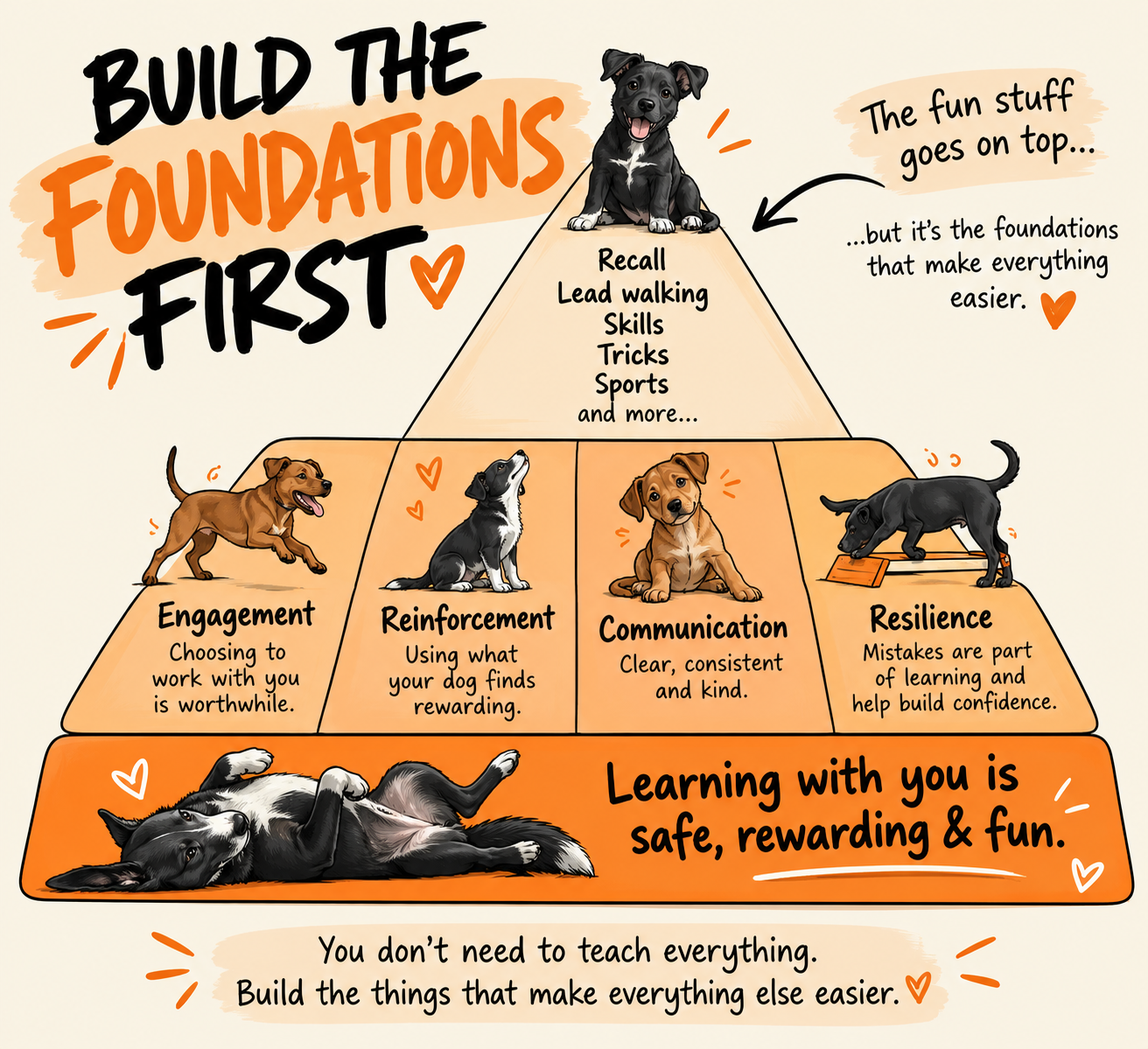
The fun stuff can come later. Build engagement, reinforcement, communication and resilience first — and everything else has much stronger foundations. 🧡
Start with reinforcement
Before worrying about what you're going to teach, work out what your puppy actually finds rewarding.
Food is an obvious one, but even within food there can be huge differences.
Their normal food might be perfectly adequate in your kitchen.
Outside, with another dog twenty metres away?
Suddenly that same piece of food may be about as exciting as a tax return.
That's useful information.
Rewards can also include toys, play, sniffing, chasing, access to something they want or simply being allowed to move forwards.
The important bit is remembering:
You don't decide what's rewarding. Your dog does.
If you're offering something your puppy doesn't particularly want in that moment, it doesn't become a reward just because you called it one.
Brea's Tip 🧡
Match the reward to the difficulty.
Easy behaviour in an easy environment might only need an everyday reward.
Hard behaviour around something your puppy desperately wants?
Pay accordingly.
You wouldn't expect the same salary for a much harder job.
Your puppy probably wouldn't either.
Teach them that you matter
I don't mean making yourself more exciting than absolutely everything in the universe.
That's neither realistic nor necessary.
I want my puppies to explore.
I want them to sniff.
I want them to notice things.
But I also want them to learn that checking back in with me is worthwhile.
That can start incredibly simply.
Your puppy looks at you?
Reward.
They choose to come towards you?
Reward.
They follow you when you change direction?
Reward.
They disengage from something interesting and reconnect with you?
Definitely reward.
You're building a history that says:
Paying attention to my human is worth doing.
And that becomes incredibly useful later.
Recall starts before you need it
Please don't wait until your puppy is sprinting towards another dog to discover whether they understand their recall cue.
Start ridiculously easy.
Say your recall cue when you're pretty confident they're going to come.
Reward them generously when they arrive.
Then — and this bit matters — let them go again sometimes.
If coming back to you always means:
FUN OVER. LEAD ON. HOME TIME.
you may accidentally make recall predict the end of everything your puppy was enjoying.
Sometimes recall should mean:
Come back → get paid → go and carry on being a dog.
That's a much better deal.
Teach them how to respond to lead pressure
This is such a small exercise, but it's one I really like puppies to understand early.
Dogs aren't born knowing that pressure on a lead means they should move towards it.
Their natural response may be to brace, pull away or fight against it.
So teach it when there's hardly any pressure at all.
Apply a tiny amount of gentle lead pressure.
The moment your puppy moves towards that pressure, release it and reward them.
They learn:
Moving towards the pressure makes it disappear.
We're not dragging them into position.
We're teaching them how to find the answer themselves.
That little skill can make lead walking, handling and everyday life much easier later.
Let them get things wrong
This one matters enormously to me.
Training shouldn't feel like a test your puppy is frightened of failing.
They're going to make mistakes.
They're going to misunderstand you.
They're going to offer the wrong behaviour.
Sometimes they'll appear to have completely forgotten something they did beautifully yesterday.
That's learning.
If every mistake creates frustration, pressure or correction, we can end up with a dog who's reluctant to try.
Instead, I want a puppy who thinks:
That didn't work. What else could I try?
That ability to cope when something doesn't immediately work is the beginning of resilience.
And trust me — you'll want that later.
Teach them to learn around distractions
You'll often hear the advice:
“Teach it somewhere quiet first, then gradually add distractions.”
That's not always how I train my puppies.
In fact, I quite like teaching new things with some distractions around from the beginning.
Not because I want to make training unnecessarily difficult, but because I want my puppies to learn an important skill alongside whatever behaviour I'm teaching:
How to learn when the world is happening around them.
If every new behaviour is first taught in a silent living room with nothing else going on, we can accidentally create a very specific picture of what “training” looks like.
Then we head outside and suddenly there are smells, dogs, people, movement and noises — and we're surprised when our puppy finds it much harder to concentrate.
Instead, I'll often choose an environment where there are manageable distractions and teach the behaviour there from the beginning.
The key word is manageable.
I'm not taking a puppy who has never learned around other dogs and trying to teach something complicated in the middle of a packed dog show.
I want enough happening that they have opportunities to notice the environment, disengage from it and come back to learning with me — without being so overwhelmed that they can't learn at all.
That means I'm not just teaching a sit, a recall or a new behaviour.
I'm also teaching:
You can notice what's happening around you and still learn.
And that's a skill I want my dogs to have for the rest of their lives.
Brea's Tip 🧡
Don't automatically remove every distraction when your puppy struggles.
Sometimes making the environment easier is absolutely the right choice. But sometimes we can adjust the training instead — make the exercise simpler, improve the reinforcement or give the puppy a moment to process what's happening.
The goal isn't a puppy who can only learn when the world is quiet.
It's a puppy who learns how to learn while the world carries on around them.
Keep training short
You do not need 30-minute puppy training sessions.
In fact, I'd much rather see 30 seconds of brilliant training than ten minutes where both you and your puppy gradually lose the will to live.
Do a few repetitions.
Reward them.
Finish.
Training can happen throughout normal life too.
Recall them from the garden.
Reward them for checking in on a walk.
Practise a tiny bit of handling before dinner.
Reward them for moving towards gentle lead pressure.
You don't necessarily need to announce:
IT IS NOW TRAINING TIME.
You're building skills all day.
Don't forget the dog in front of you
This is probably the most important foundation of all.
Your puppy isn't somebody else's puppy.
One puppy might be incredibly confident but struggle with frustration.
Another might be thoughtful and cautious.
One might desperately want to interact with every dog they see.
Another might find other dogs overwhelming.
One might work beautifully for food.
Another might come alive when you bring out a toy.
So don't get too caught up in what your puppy should be doing by a particular age.
Watch the dog you've actually got.
Ask what they need.
And build from there.
Reality check
Your puppy does not need to be perfectly trained.
They don't need a flawless recall at 14 weeks.
They don't need competition-level heelwork.
They don't need seventeen tricks.
And they definitely don't need to spend their entire puppyhood being drilled through exercises because you're frightened of getting it wrong.
You have time.
Build the relationship.
Build confidence.
Build reinforcement.
Build communication.
Build resilience.
Those are the foundations.
Everything else can go on top.
Because puppy training isn't really about seeing how much you can teach before they reach six months old.
It's about creating a dog who enjoys learning with you.
And that's something you'll be able to use for the rest of their life. 🧡
Want to build those foundations together?
You don't need to teach your puppy everything at once.
We can build the things that make everything else easier — engagement, reinforcement, communication, resilience and learning around real-life distractions — and then build the skills that matter to you on top.