Scorch has taught me an awful lot about dog training.
Mostly by making absolutely sure that many of the things I thought I knew didn't work quite the same way with him. 😂
When he was younger, Scorch had virtually zero resilience when it came to training.
If he got something wrong and the reward didn't come, he didn't simply try again.
He'd move away. Sometimes he'd lie down. And quite often, as far as Scorch was concerned, that training session was over.
It would have been very easy to look at the behaviour I was trying to teach and think I needed to make the criteria clearer, change the reward or find a better way of explaining the exercise.
But the exercise wasn't really the problem.
Getting it wrong was.
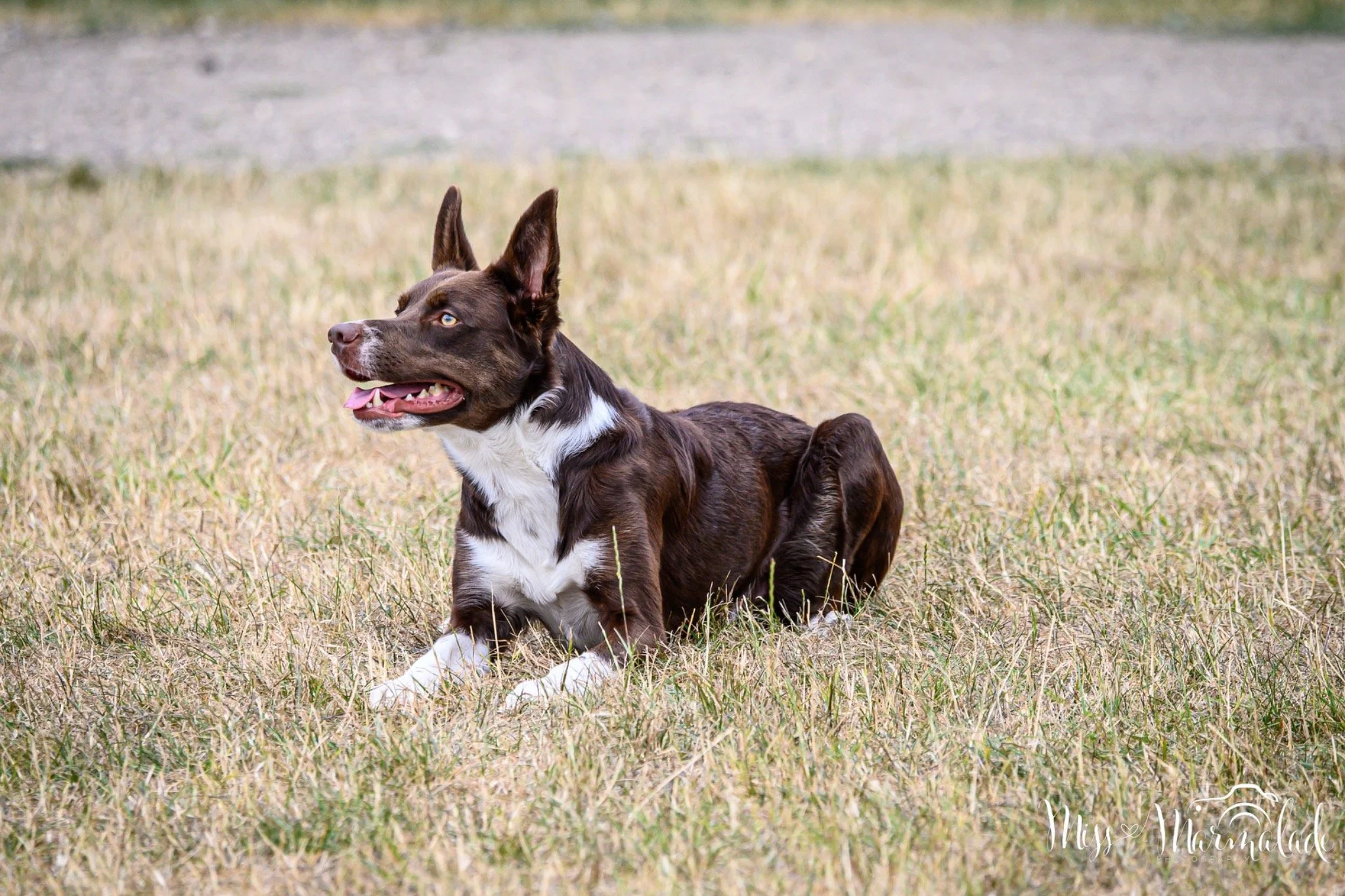
Red and white Border Collie lying in a grassy field looking up at his handler.
Sometimes the behaviour isn’t the thing you need to train
We tend to think about dog training in terms of behaviours.
Recall. Loose lead walking. Stay. Weaves. Contacts. Whatever it is we're trying to teach.
We decide what we want the dog to do, break it into achievable steps and reinforce the behaviour we want.
But learning also involves something not going quite right sometimes.
Your dog makes the wrong choice. The reward doesn't happen. You change the picture. You ask them to try again.
For some dogs, that's no big deal.
For others, being wrong can be incredibly difficult.
And if your dog can't stay engaged in the learning process when something doesn't work, repeatedly drilling the behaviour itself isn't necessarily going to solve the problem.
Resilience is a skill too
When I talk about resilience in training, I mean a dog's ability to cope when things don't go exactly as expected.
Maybe they make the wrong choice. Maybe the reward doesn't arrive when they thought it would. Maybe something becomes a little harder, or they have to stop, think and try something different.
Some dogs can shrug that off and immediately have another go.
Others find it much harder.
And that's important, because resilience isn't the same as obedience, motivation or intelligence.
A dog can be incredibly keen to work, learn things quickly and understand exactly what you're teaching — but still really struggle emotionally when they get something wrong.
That's exactly where Scorch was.
Building resilience doesn't mean letting your dog fail
If a dog already finds failure difficult, repeatedly putting them in situations where they're wrong and expecting them to “learn to cope with it” isn't necessarily going to make them more resilient.
For some dogs, it'll do the opposite.
With Scorch, I needed him to learn that getting something wrong wasn't the end of the training session.
So rather than deliberately making things difficult, I started creating lots of small opportunities for him to experience something not quite working — without it becoming a big deal.
Sometimes I'd help him.
Sometimes I'd make the next repetition easier.
Sometimes I'd change what I was asking completely.
And sometimes, I'd reward the effort even when the answer wasn't quite right.
That last one was particularly important for Scorch.
There are times when maintaining really clear criteria matters. But with him, there were also times when being absolutely black and white about right = reward, wrong = nothing was making him so worried about getting it wrong that he stopped wanting to try at all.
So sometimes the thing I wanted to reinforce wasn't the finished behaviour.
It was the fact that he'd stayed in the game and had another go.
As his confidence and resilience have grown, I've been able to ask for more, tighten the criteria and let him work things out without him falling apart when the reward doesn't come.
The goal was never to reward everything forever.
It was to build a dog who felt safe enough to keep trying when everything wasn't perfect.
Sometimes slowing down gets you there faster
I deliberately waited until Scorch was nearly two before I started properly training his dogwalk and contacts.
Partly because he's a very tall dog with extremely long legs that took him quite some time to realise actually belonged to him. 😂
But mostly because I knew the training would ask something of him that he wasn't ready for yet.
Running contacts require repetition, problem-solving and the ability to cope when a repetition doesn't produce the reward you expected.
I could have started earlier.
I could probably have got the behaviour trained earlier.
But getting the behaviour wasn't the only thing that mattered.
The dog I was going to be training it with mattered more.
What does this look like with your dog?
A dog who struggles with resilience won't always move away and lie down like Scorch did.
Sometimes it's much more subtle.
They might start sniffing, become distracted, slow down, offer lots of behaviours frantically, get frustrated, bark, grab at you or simply seem to lose interest in something they were happily doing thirty seconds earlier.
And it's easy to look at that and think they're being stubborn, that they don't understand, or that you need to make yourself more exciting.
But sometimes the behaviour you're seeing isn't really about the exercise at all.
Sometimes your dog is telling you that they're finding the process of learning difficult.
That's when it's worth looking at the whole picture.
Are they getting enough opportunities to be successful? Is the jump between one step and the next too big? Do they understand what earns reinforcement? What happens when they make a mistake? And most importantly — do they feel confident enough to keep trying?
That doesn't mean removing all challenge from your training.
Dogs need opportunities to problem-solve, experience frustration and learn that not every attempt will immediately result in reinforcement.
But there's a huge difference between giving a dog a challenge they can work through and repeatedly putting them in a situation they don't yet have the skills to cope with.
Train the dog in front of you
Scorch still isn't a dog who loves being wrong. 😂
And I don't need him to be.
What has changed is his ability to cope with it.
He can make a mistake and stay engaged. He can try something, realise it didn't work and have another go. I can withhold a reward without watching his confidence disappear along with it.
And because of that, I can now ask much more of him than I could when he was younger.
I could have pushed ahead with the behaviours I wanted sooner.
Instead, I spent time working on the dog who was going to have to learn them.
Sometimes progress isn't teaching your dog the next behaviour.
Sometimes it's giving them the skills they'll need to learn everything that comes after it.
And that, for me, is what training the dog in front of you really means. 🧡
Does your dog find getting it wrong really hard?
Some dogs bounce back from mistakes without a second thought. Others can lose confidence, disengage or stop trying altogether.
If that sounds familiar, Everyday Coaching gives us the time to look beyond the individual behaviour and work on confidence, resilience and how your dog feels about learning — adapting the training as we discover what helps your dog succeed.
Because sometimes the thing we need to train isn't the behaviour itself. It's helping your dog feel safe enough to keep trying. 🧡