

I made a mistake recently.
I took Shrimp to the beach and assumed she'd be absolutely fine.
This is a dog with years of training. Her recall is good. She's used to working around distractions. She's competed in busy environments, travelled all over the place and generally has a pretty decent understanding of how to use her brain.
So naturally, I arrived at the beach expecting to have a lovely, relaxing walk.
Shrimp had other ideas.
The second her feet hit the sand, she completely lost her mind. 😂
Zoomies. Seagulls. Sand. Sea. Approximately seventeen thousand things that were apparently more important than me.
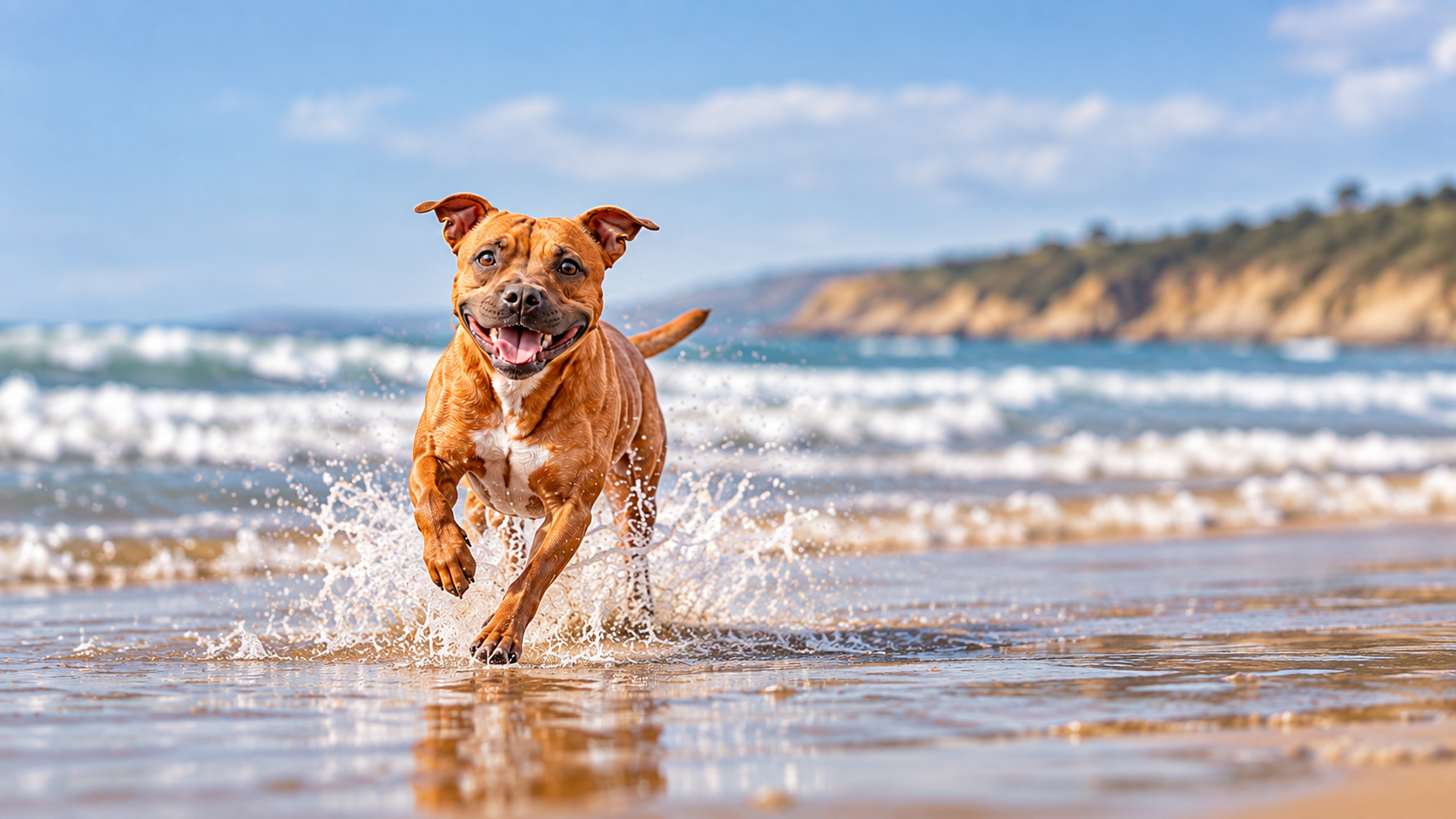
Red Staffordshire Bull Terrier running through shallow water on the beach.
Thankfully, I'd put her harness and flexi lead on before we got out of the car because I was also trying to keep an eye on my two small children.
It turned out to be one of my better decisions.
Because the beautifully trained dog I'd arrived with had apparently been replaced by a small orange lunatic.
And on the way home, I realised something.
I don't think I'd ever actually taken Shrimp to the beach before.
Your dog hasn't forgotten their training.
One of the easiest traps to fall into with dog training is assuming that because your dog can do something really well in one place, they understand that the same rules apply everywhere.
Your dog might have a brilliant recall on your usual walk. They might walk beautifully on lead around your neighbourhood, focus perfectly in training class or nail an exercise every single time in your kitchen.
Then you take that same behaviour somewhere completely new and suddenly it feels like you’re back at square one.
And it’s very easy to think:
“But they KNOW this.”
They do. In the environment where they’ve learned and practised it.
Dogs aren’t particularly good at automatically generalising what they’ve learned. Changing the environment changes the whole picture — the sights, smells, sounds, distractions and how your dog feels in that moment.
The behaviour might technically be the same.
But to your dog, the situation isn’t.
New environments change more than the scenery
A new environment can also completely change your dog’s emotional state.
Some dogs become worried or cautious somewhere unfamiliar. Others become distracted. Some get frustrated.
And some, like Shrimp apparently, arrive at the beach and immediately choose chaos. 😂
Excitement matters because the more aroused your dog becomes, the harder it can be for them to access skills they can normally perform easily.
That doesn’t mean they’re being stubborn, ignoring you deliberately or that your training has somehow disappeared.
It means the version of the behaviour you’ve trained isn’t strong enough for this version of the environment yet.
And that distinction really matters.
Because if we assume the dog is simply choosing not to listen, the answer tends to become ask again, get firmer, expect more.
If we recognise that the environment has made the task significantly harder, we can actually train for it.
So what do you do?
You make the picture easier again.
That might mean:
adding distance from whatever is exciting or worrying them
using a lead or long line while you practise
lowering your expectations temporarily
rewarding much easier versions of the behaviour
giving your dog time to take in the environment before asking them to work
practising the same skills in lots of different places, gradually increasing the difficulty
You don’t need to throw your criteria out of the window. You just need to recognise when you’ve accidentally made the exercise ten times harder.
The trained dog is still in there
Shrimp hadn’t forgotten how her recall.
She hadn’t suddenly become an untrained dog because we stepped onto a beach.
I’d simply put a dog who had never experienced that particular environment into an incredibly exciting situation and expected her existing training to transfer immediately.
That bit was on me.
So we trained it.
We went back with management in place. I gave her time to take everything in, worked on engagement and recall in that environment and gradually gave her more freedom as she showed me she could cope with it.
And now?
She’s absolutely fine off lead at the beach.
Not because she eventually “got over it”. Not because I kept calling her until she finally listened. And definitely not because she magically became less interested in being feral. 😂
Because we actually trained the behaviour in the environment where I needed it.
And I think that’s the bit we sometimes forget.
We spend so much time teaching our dogs what behaviours mean that it’s easy to overlook teaching them that those behaviours still apply when the picture changes.
Your dog might know the behaviour.
Sometimes they just haven’t learned to do it there yet.
Does your dog know it at home... but apparently nowhere else?
If your dog's training disappears the moment the environment changes, it doesn't mean they've forgotten everything — and it doesn't mean you need to start again.
Everyday Coaching gives us the chance to build those skills into real life, gradually adding the distractions, environments and challenges your dog needs to learn around.
Because the goal isn't a dog who can do it perfectly in your kitchen.
It's a dog who can use those skills when you actually need them. 🧡