One of the easiest traps to fall into in agility is training the thing that went wrong.
Your dog misses a contact, so you train contacts.
They break their start line, so you train start lines.
They come out of the weaves, so you train weaves.
And sometimes, that's exactly what you need to do.
But sometimes the obstacle isn't actually the problem.
After nearly 20 years competing in agility, and years of coaching dogs and handlers, one of the biggest things I've learned is to look beyond the mistake itself.
Because I've seen dogs with brilliant contacts miss them in the ring.
Dogs with solid weaves suddenly pop out at pole ten.
Dogs who can hold a start line all day in training launch themselves before their handler has taken two steps at a competition. 😂
And it's very easy to look at those moments and think the behaviour needs more training.
But before I train the behaviour, I want to know why it disappeared in the first place.
Was the dog too aroused to access it?
Did something knock their confidence?
Was the handling different?
Did speed change the picture?
Was frustration building before we even reached that obstacle?
Or is there actually a gap in their understanding?
Because if I don't know what's causing the problem, I can spend an awful lot of time training the wrong thing.
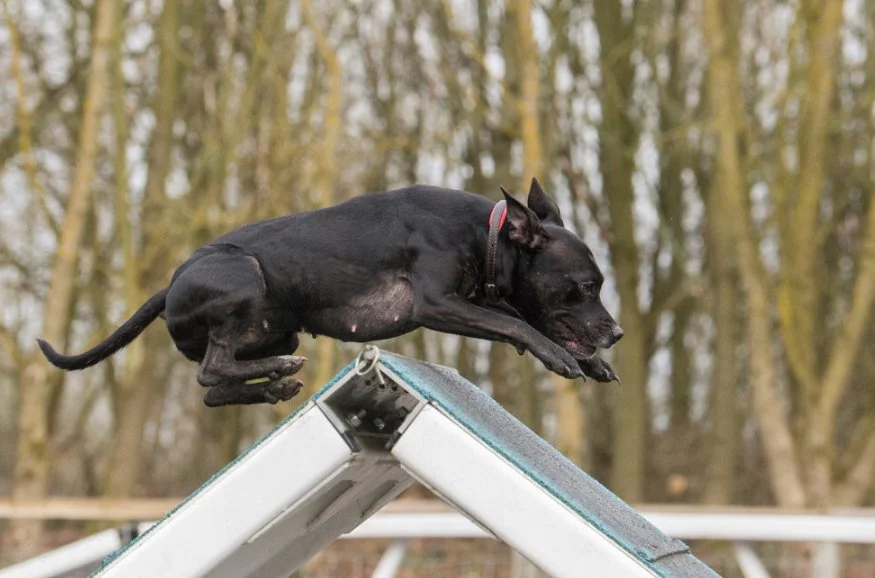
Black dog running over an A-frame on an agility course.
The behaviour you see is information
When something goes wrong on an agility course, the mistake itself gives us information.
But it doesn't necessarily give us the answer.
A missed contact tells me the dog didn't meet their contact criteria on that repetition. It doesn't tell me why.
A dog coming out of the weaves tells me they couldn't complete them in that moment. It doesn't automatically mean they don't understand their weaves.
And a dog breaking their start line tells me they couldn't hold it in that particular situation — not necessarily that we need to go home and practise another hundred start lines.
This is where I think looking at the whole dog, rather than just the performance, becomes really important.
What happened before the mistake?
What was their arousal like?
Were they getting increasingly frustrated as they went around the course?
Did they look confident?
Were they able to think, or were they just reacting to everything at a hundred miles an hour?
Did something earlier in the course affect what happened three obstacles later?
And equally, we need to look at ourselves.
Did our handling change? Was our timing different? Did we put pressure on the dog that they weren't expecting? Are we behaving differently because we're in a competition rather than training?
Sometimes, when you start looking at everything surrounding the mistake, the thing you thought you needed to train isn't actually the problem at all.
Can your dog do the behaviour — or can they use the behaviour?
There's a difference between a dog knowing a skill and being able to access that skill when things get harder.
Your dog might have beautiful weaves in training.
But can they still weave when they're highly aroused?
Can they do it after a really fast sequence?
Can they find the correct entry when you've just asked them to turn away from the most obvious line?
Can they do it somewhere unfamiliar, with another dog barking outside the ring, people standing around the edge and you feeling slightly more nervous than usual?
Knowing how to do something is only part of the picture.
For me, good agility training isn't just about teaching the individual behaviours.
It's about gradually giving the dog the skills and experience they need to use those behaviours in all the situations we're eventually going to ask for them.
And when they can't?
That's when I want to work out what changed, rather than immediately assuming the behaviour itself needs fixing.
Sometimes it isn’t a training problem
Shrimp’s dogwalk is a really good example of this.
A long time ago, she had a fall from the dogwalk.
She wasn’t injured, but it knocked her confidence massively. After that, she started taking power out of the obstacle. She became more cautious and, although she still knew how to do a dogwalk, the way she performed it had completely changed.
On paper, it would have been easy to look at what was happening and think:
Her dogwalk needs fixing.
But the actual dogwalk behaviour wasn't really the problem.
Her confidence was.
If I'd focused purely on criteria — hitting the contact, getting the right foot placement, rewarding the correct performance — I'd have been concentrating on the bit I could see rather than the reason it was happening.
So rebuilding her dogwalk wasn't just about training the obstacle.
It was about helping her feel safe enough to run it properly again.
That meant giving her time, building her confidence back up and not asking for more than she was ready to give me just because I knew what she was physically capable of.
And it took time.
There were plenty of moments where I knew the dogwalk she could do was still in there, but she wasn't confident enough to give me that performance yet.
Then eventually, I started seeing it again.
Not just in training, but in the ring.
The behaviour hadn't needed teaching again. The dog performing it had needed support.
And that's a distinction I think matters far beyond contacts.
A dog might slow down because they're worried.
They might lose a start line because their arousal has tipped over.
They might struggle with their weaves because something about the approach has knocked their confidence.
They might start knocking poles because they're rushing, frustrated, tired or simply not thinking about their body.
There are dozens of possible explanations — which is exactly why I don't want to jump straight from “this went wrong” to “this is what we need to train.”
So what do you actually train?
Before deciding that, I want to understand the problem.
Sometimes the answer genuinely is more training of the behaviour.
There might be a gap in the dog's understanding. The criteria might not be as clear as we thought. We might have progressed too quickly or simply not trained enough variations of the skill.
And that's fine.
But other times, we need to work on confidence. Or arousal. Or frustration. Or resilience. Or the handler's skills. Or the dog's ability to perform something they already know when the picture around it changes.
The goal isn't to find a more complicated explanation for every mistake.
It's simply to be curious enough to ask why before deciding what to do next.
Because once you understand what's driving the problem, you can train the thing that's actually going to make a difference.
Train the dog, not just the course
Agility is full of behaviours.
Contacts, weaves, start lines, jumping, handling skills — all the individual pieces we spend hours teaching and refining.
But there's still a dog underneath all of them.
A dog with confidence, emotions, frustrations, strengths and weaknesses. A dog whose ability to perform those skills can change depending on the environment, their arousal, what happened thirty seconds earlier or how secure they feel in what we're asking them to do.
And I think sometimes, in a sport where we're so focused on performance, it's easy to forget that.
When something goes wrong, I don't just want to know what the dog did.
I want to understand why they did it.
Because the answer to that question is what tells me where our training needs to go next.
Sometimes we'll train the obstacle.
Sometimes we'll train the handling.
Sometimes we'll work on confidence, arousal, frustration or resilience.
And sometimes the best thing we can do is recognise that the dog in front of us needs something completely different from the dog we trained before them.
Good agility training isn't just about creating better behaviours.
It's about creating a dog who can confidently use those behaviours when it matters.
And for me, that's always going to be more important than simply fixing the thing that went wrong in the ring. 🧡
Stuck on something in your agility training?
The problem that shows up in the ring isn't always where the training needs to start.
Whether you're dealing with confidence, arousal, handling, independence or a skill that's falling apart under competition pressure, we can look at the whole picture rather than endlessly drilling the bit that keeps going wrong.
Because better agility isn't always about doing more agility. 🧡