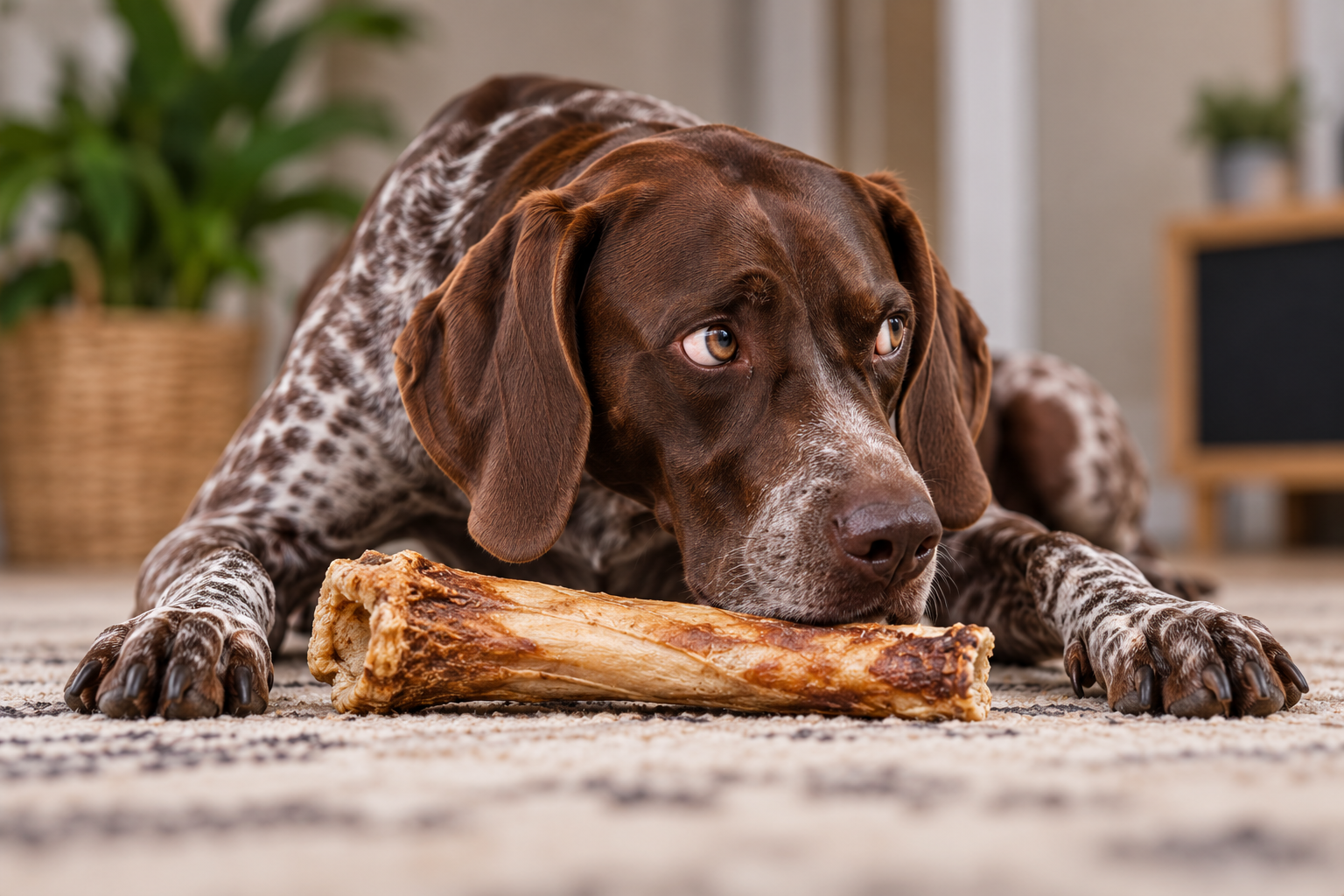
Just because something doesn't seem particularly valuable to us doesn't mean our dogs feel the same way. 🧡 Resource guarding often comes from a concern about losing access to something important, and understanding that emotion is the first step towards helping our dogs feel more secure.
You've given your dog a lovely chew. They're happily enjoying it, so you walk past to put the kettle on.
And suddenly, they freeze.
Perhaps they lower their head over the chew. Maybe they give you a sideways look. Or perhaps they growl.
You weren't even planning to take it away.
So why are they behaving as though you're about to steal their most prized possession?
This behaviour is called resource guarding, and while it can be worrying for owners, understanding why it happens is the first step towards helping your dog feel differently.
And no, it doesn't mean your dog is trying to dominate you.
What is resource guarding?
Resource guarding describes behaviour intended to maintain access to something a dog considers valuable.
That might be their dinner, a favourite toy or a particularly delicious chew.
But it can also include things we wouldn't necessarily think of as resources.
A comfortable sleeping spot. A stolen sock. A doorway. Access to a particular person.
And sometimes, something that seems completely insignificant to us.
Because here's the important bit:
Your dog decides what's valuable. Not you.
A dog might happily let you pick up their food bowl but become incredibly uncomfortable when you approach them with a tissue they've stolen from the bin.
It's not necessarily about the monetary value, the size of the object or even how much they appear to enjoy it.
It's about what that resource means to the individual dog, in that particular situation.
Resource guarding doesn't always look like growling
When we think about guarding, we tend to picture a dog snarling over a food bowl.
But guarding behaviour can be much more subtle.
You might notice your dog:
Eating faster when someone approaches.
Turning their head or moving away with an item.
Positioning their body between you and something they value.
Becoming very still when you get closer.
Lowering their head over an object.
Showing the whites of their eyes while keeping their head still.
Growling, snapping or lunging when someone approaches.
Not every dog will display all of these behaviours, and not every instance of these behaviours means a dog is resource guarding.
Context matters.
But one thing I really want owners to understand is that growling often isn't the beginning of the conversation.
There may have been several quieter attempts to communicate discomfort before the growl happened.
And if we miss those early signals, it's easy to think the dog reacted completely out of nowhere.
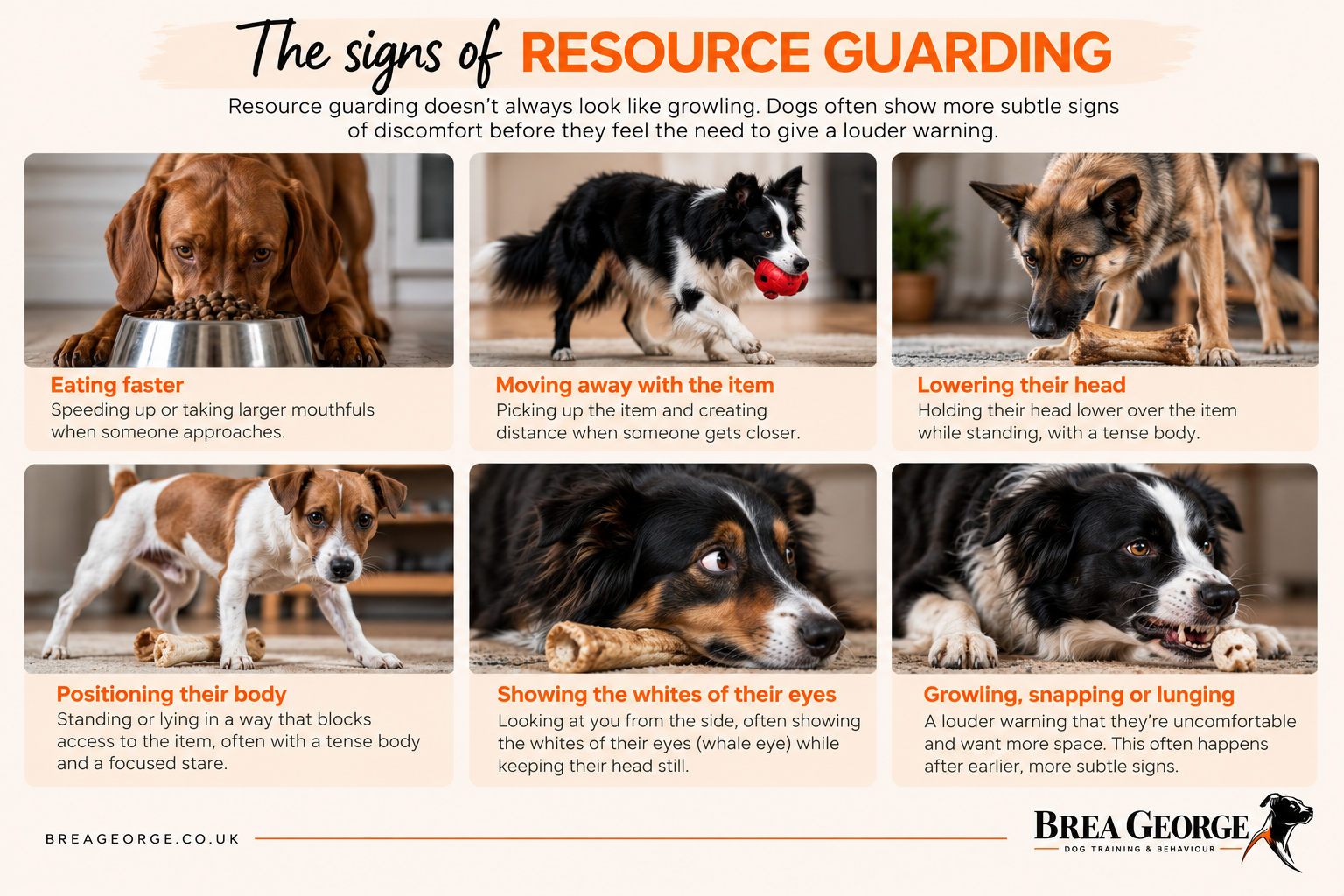
Resource guarding doesn't always begin with a growl. 🐾 Dogs often communicate their discomfort through much subtler changes in body language, from moving away with an item to becoming tense, still or showing the whites of their eyes. Learning to recognise these early signals gives us an opportunity to understand how our dogs are feeling before a situation escalates. 🧡
Why does my dog feel the need to guard things?
This is where we need to look beyond the behaviour itself.
Resource guarding isn't simply a dog being naughty, stubborn or possessive.
At its core, it often involves a dog attempting to prevent the loss of access to something they value.
But the reasons behind that concern can vary enormously.
For one dog, previous experiences may have taught them that people approaching means something gets taken away.
For another, competition with other dogs may influence how secure they feel around food or toys.
Some dogs may have a stronger predisposition towards guarding certain resources, while others may develop the behaviour in particular circumstances.
Pain, illness, stress and changes in the environment can also influence how a dog responds.
And sometimes, we won't be able to identify one neat, obvious reason.
Two dogs can display very similar guarding behaviour for different reasons.
That's why understanding the individual dog matters far more than applying the same training exercise to every case.
But I've always taken things away so my dog knows I'm in charge!
This is one of those pieces of advice that has been passed around for years.
Put your hand in your puppy's food bowl.
Take their dinner away halfway through.
Remove their toys regularly so they learn that you're allowed to.
The intention is often to prevent resource guarding.
Unfortunately, it can have the opposite effect.
Imagine you're enjoying a lovely meal, and every so often someone walks over and removes your plate.
Sometimes they give it back.
Sometimes they don't.
You might start paying rather close attention whenever that person approaches.
And if it keeps happening, you might become increasingly concerned about protecting your dinner.
For some dogs, repeated removal of valued items can create exactly the association we were hoping to avoid.
People approaching predict that good things disappear.
That doesn't mean we should never need to take something away from our dogs.
Of course there will be situations where we need to retrieve an unsafe object or move something.
But there's an enormous difference between teaching a dog to cooperate with us and repeatedly taking things away simply to prove that we can.
Our goal should be to build trust, not demonstrate control.
Why you shouldn't punish a dog for growling
I understand why growling makes people uncomfortable.
It can be frightening, particularly when it's directed towards a family member.
And it's very tempting to tell the dog off.
But growling is communication.
It's information about how your dog is feeling in that moment.
If we punish the growl, we might stop the noise.
But have we changed the emotion that caused it?
Not necessarily.
In some cases, we've simply taught the dog that communicating their discomfort has unpleasant consequences.
The concern about losing the resource may still be there.
And if those earlier warnings become less likely, we risk being left with fewer opportunities to recognise that the dog is struggling before the situation escalates.
That doesn't mean every dog that has been told off for growling will suddenly bite without warning.
Behaviour is rarely that predictable.
But suppressing communication without addressing the underlying problem is not the same as resolving resource guarding.
I would much rather understand what a dog is trying to tell me than teach them they aren't allowed to tell me.
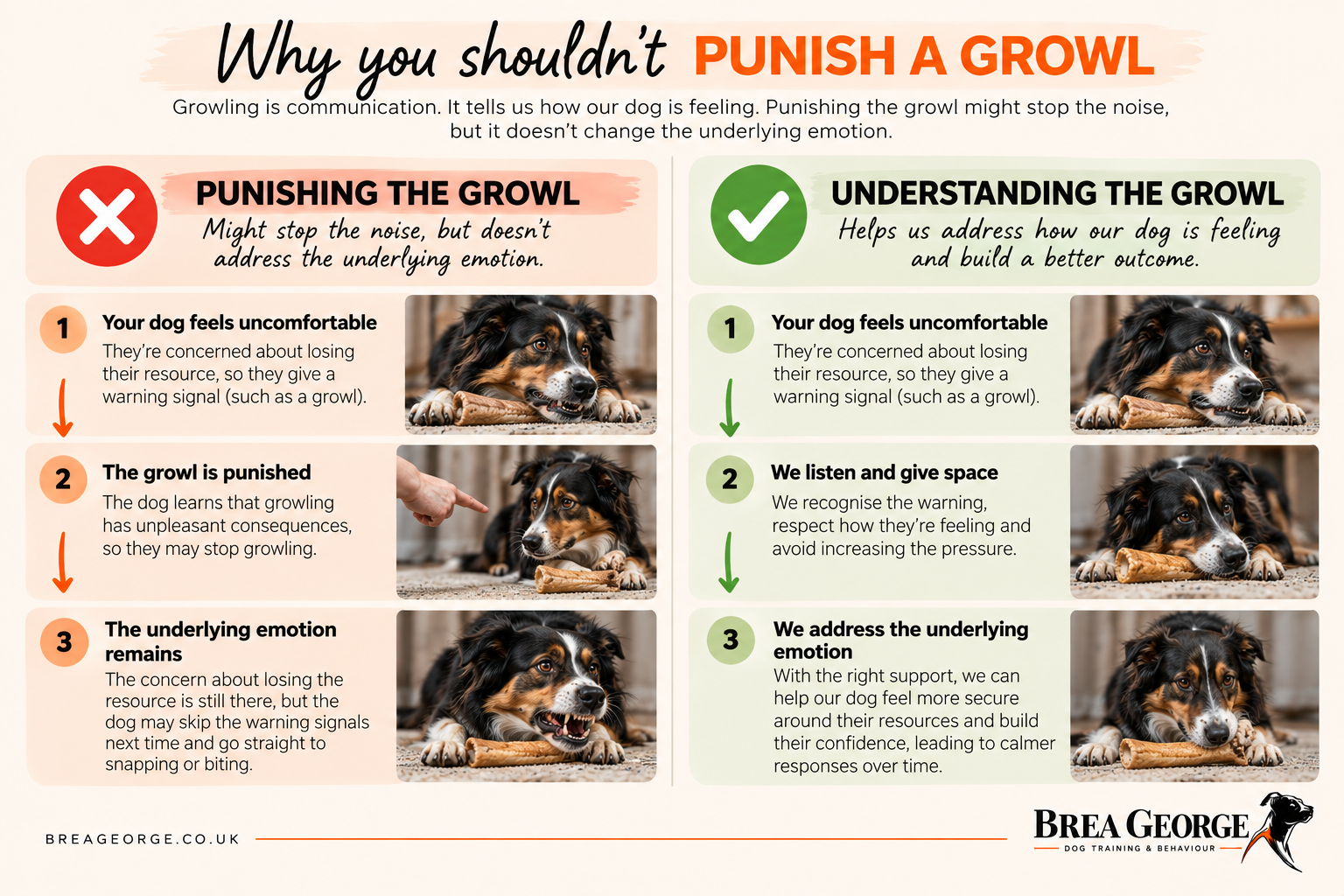
Growling is communication, not something we should simply try to eliminate. 🧡 Punishing a growl might stop the warning, but it doesn't necessarily change how the dog feels about losing something valuable. Understanding the emotion behind the behaviour gives us the opportunity to build trust, improve confidence and help our dogs feel more secure.
My dog only guards things from other dogs. Is that different?
It can be.
Some dogs are perfectly comfortable with people approaching their belongings but become tense when another dog comes nearby.
Others guard things from people but happily share space with other dogs.
And some dogs struggle with both.
The behaviour may look similar, but the social context is different.
For example, a dog living in a multi-dog household may become concerned about another dog approaching their food, particularly if there's a history of competition or conflict.
Another dog might guard access to a resting place when a housemate comes too close.
We need to consider the relationships between the dogs, the environment, previous experiences and the specific resource involved.
And importantly, dogs do not need to share everything to live happily together.
Feeding dogs separately, providing individual resting spaces and managing access to particularly valuable items can be sensible, permanent arrangements.
Management isn't a failure to train.
Sometimes it's simply good welfare and good household management.
What if my dog guards me?
This is an interesting one, because owners often describe a dog as being protective or jealous.
Perhaps your dog growls when another dog approaches you on the sofa.
Or they push between you and another dog when you're giving attention.
It's tempting to assume they're guarding you in the same way they might guard a chew.
And sometimes, maintaining access to a person may indeed be part of what's happening.
But behaviour around people can have several possible motivations, including anxiety, frustration, conflict or previous learning.
We shouldn't automatically label every dog that growls near their owner as resource guarding.
We need to look at the circumstances and the function of the behaviour.
Because once again, what the dog is doing doesn't automatically tell us why they're doing it.
Can resource guarding get worse?
Yes, it can.
Particularly if the dog repeatedly experiences situations that reinforce their concern about losing access to resources, or if their warning signals are ignored.
For example, imagine a dog growls when someone approaches their chew.
The person continues towards them and attempts to take it.
The dog may learn that a growl wasn't enough to prevent the situation they were worried about.
On another occasion, they might use a more intense response.
But resource guarding doesn't always progress in a straight line.
Some dogs display relatively mild guarding behaviour that remains stable for years. Others show considerable variation depending on the resource, the environment and who's approaching.
That's why it's important not to wait until a dog has bitten someone before taking their discomfort seriously.
What should I do if my dog is guarding something?
First, don't turn it into a confrontation.
If your dog is already tense, growling or showing signs that they're uncomfortable with your approach, trying to prove a point by taking the item away is unlikely to help.
Give them space and avoid unnecessary pressure.
In the longer term, it's worth looking carefully at when the guarding occurs.
Is it only around food?
Does it happen with stolen objects?
Is another dog involved?
Does it happen in particular rooms or when the dog is resting?
Have there been any recent changes in the household or in your dog's behaviour?
These details can tell us far more than simply knowing that a dog growls.
For now, sensible management may include:
Giving dogs space to eat and enjoy valuable chews without being disturbed.
Separating dogs when high-value resources are available.
Preventing children from approaching dogs who are eating, resting or holding valued items.
Avoiding deliberately testing whether your dog will allow you to take something.
Reducing opportunities for conflict while you seek appropriate support.
If your dog has something dangerous, avoid reaching into their mouth or physically confronting them if doing so puts anyone at risk. Seek appropriate urgent advice for potentially toxic or hazardous items.
And if guarding has appeared suddenly, particularly alongside other changes in behaviour, a veterinary check is important to investigate possible pain or illness.
But surely I need to teach my dog to give things up?
Absolutely.
Being able to safely release items and cooperate with us is a really useful life skill.
But teaching those skills and addressing established resource guarding are not necessarily the same thing.
A dog who happily swaps a toy during a relaxed training session may still feel extremely uncomfortable when someone approaches a particularly valuable chew.
And repeatedly offering food to get close to a guarding dog isn't automatically safe or appropriate.
The training needs to take account of the dog's emotional response, learning history, the value of the resource and the risk involved.
For dogs already showing significant guarding behaviour, particularly where snapping or biting has occurred, I'd strongly recommend individual professional support rather than attempting to follow a generic online exercise.
The goal isn't to make your dog give everything up
This is probably the biggest shift in thinking I'd like owners to take away from this article.
Successful resource guarding work isn't about proving that we can take absolutely anything from our dogs whenever we want.
It's about helping them feel more secure.
Helping them learn that our presence doesn't automatically mean losing something important.
Developing cooperative skills that make everyday life safer and easier.
And creating an environment where they don't constantly feel the need to protect what they have.
Because ultimately, I don't want a dog who simply stops growling when someone approaches their dinner.
I want a dog who genuinely feels less worried about that person approaching in the first place.
And those are two very different outcomes.
Does your dog growl or become uncomfortable around food, toys or other things they value?
Resource guarding can be incredibly stressful to live with, particularly when children or other dogs are involved.
But you don't have to work it out on your own.
My coaching focuses on understanding the individual dog, identifying what's driving their behaviour and building a practical plan around both your dog and your everyday life.
Training built around your dog.